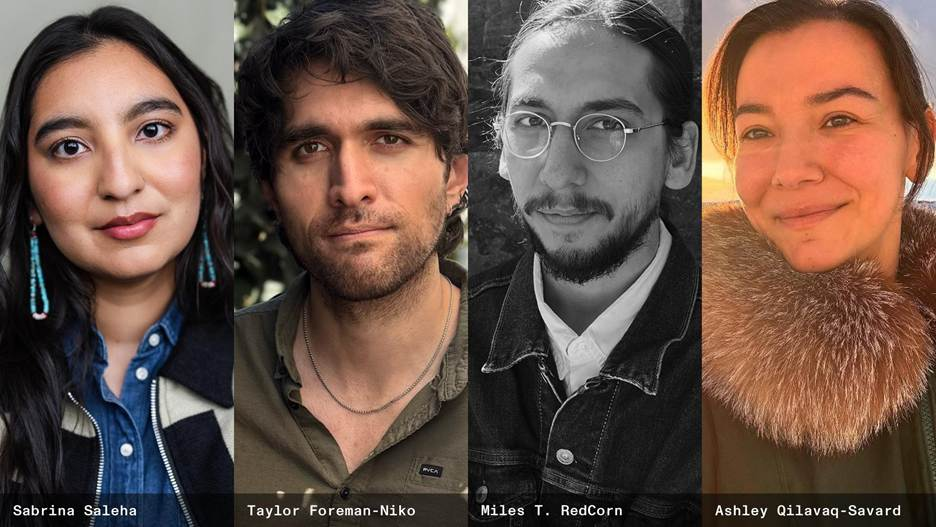
The Sundance Institute announced the fellows selected for its 2026 Native Lab, a cornerstone initiative of the Institute’s Indigenous Program aimed at advancing Indigenous storytelling in film and television.
The lab will take place April 6–11 in Santa Fe at Hotel Santa Fe. Since its launch in 2009, the Native Lab has provided Indigenous filmmakers with a supportive, immersive environment to develop projects and refine their artistic voices under the mentorship of established industry advisors.
This year’s program will support four fellows and two artists-in-residence, all of whom center Indigeneity in their work. Over five days, participants will engage in one-on-one feedback sessions, script readings, and roundtable discussions, while building community on Native land.
The 2026 fellows include three U.S.-based filmmakers—Taylor Foreman-Niko (Samoan), Miles T. RedCorn (Osage/Caddo), and Sabrina Saleha (Navajo)—as well as Canadian filmmaker Ashley Qilavaq-Savard (Inuk/Inuit), selected in partnership with the Indigenous Screen Office. The artists-in-residence are Sayun Simung (Tayal) and Taylour Chang (Kanaka Maoli), who will attend while in script development.
Creative advisors for this year’s lab include Patrick Brice, Bernardo Britto, Alex Lazarowich (Cree), and Graham Foy. The program is overseen by Adam Piron, director of the Institute’s Indigenous Program, alongside Senior Manager Ianeta Le’i and Coordinator Katie Arthurs (Chickasaw).
“The Native Lab is grounded in storytelling development and how that can progress when it’s approached in community through a lens of Indigeneity,” said Piron. “We’re grateful for our advisors and excited for our fellows — this program is impactful because of the generosity all involved bring to the experience, and our Indigenous Program team is looking forward to the development of these projects and storytellers as they come together to share their work and insights in Santa Fe this week.”
Indigenous artists have been part of the Sundance Institute’s labs since its earliest days, with participation dating back to 1981. The Indigenous Program was formally established in the mid-1990s to more intentionally support Native creators. Since then, the Native Lab has helped launch the careers of numerous acclaimed filmmakers, including Sydney Freeland, Sterlin Harjo, Sky Hopinka, Shaandiin Tome, Erica Tremblay, and Taika Waititi.
2026 Native Lab Fellows and Projects:
- Taylor Foreman-Niko (Writer-director) — The Long Fang (U.S.): A half-Samoan man returns to his estranged family and confronts an ancient demon that feeds on shame, forcing him to face buried secrets while fighting to save his cousin. Foreman-Niko, based in Los Angeles, was previously recognized on the 2022 BloodList and participated in the PEAK Writers Fellowship and 2024 Stowe Narrative Lab.
- Ashley Qilavaq-Savard (Writer-director-producer) — Carrying (Canada): A woman grappling with infertility and loss seeks motherhood in an unexpected way, discovering a child buried in the land of her home community. Qilavaq-Savard is an Inuk writer and filmmaker from Iqaluit whose work explores decolonization and Indigenous narratives.
- Miles T. RedCorn (Writer-director) — Once Upon a Time in Indian Country (U.S.): Set in the late 1990s, the story follows a young Native attorney navigating the high-stakes world of Indian gaming, where his ambitions collide with crime, corruption, and personal turmoil. RedCorn, from Oklahoma, draws on classic cinema to explore sovereignty and overlooked periods of Native history.
- Sabrina Saleha (Writer-director) — Grief Camp (U.S.): A rebellious Navajo teenager attends an all-Native grief camp that turns out to be a liminal space between life and death, where she must solve magical riddles to reunite with her brother. Saleha is a staff writer on Dark Winds and an award-winning filmmaker whose work centers contemporary Native life, family, and healing.
The Sundance Institute Indigenous Program is supported by a coalition of partners, including the Federated Indians of Graton Rancheria, The 11th Hour Project, the Robert Wood Johnson Foundation, and others committed to advancing Indigenous media and storytelling.