Editor’s Note: This article is part of Native News Online’s America 250: A Republic Built on Native Land initiative.
As the United States marks its 250th anniversary in 2026, comparisons between President Gerald Ford’s Bicentennial celebration in 1976 and President Donald Trump’s Freedom 250 observance reveal two very different visions of how the nation should commemorate its history.
Both anniversaries arrived during periods of political division and uncertainty. Yet the tone, symbolism, and activities associated with each celebration reflect contrasting approaches to patriotism, history, and national identity.
When Ford presided over the nation’s Bicentennial, America was still recovering from the Vietnam War and the Watergate scandal that had forced President Richard Nixon from office less than two years earlier. Public trust in government was low, and Ford viewed the Bicentennial as an opportunity to heal the nation and renew confidence in American democracy.

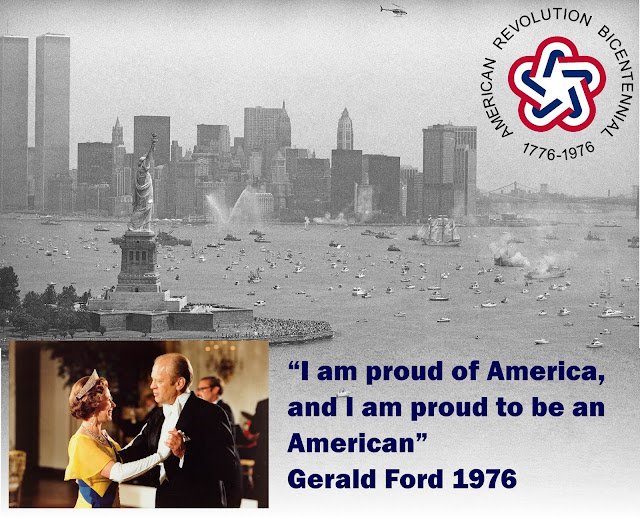
The centerpiece of Ford’s celebration was the nation’s founding history. On July 4, 1976, he participated in festivities in New York Harbor surrounding the Statue of Liberty and Operation Sail, one of the largest gatherings of tall ships in modern history. More than 200 vessels from around the world sailed into New York Harbor as symbols of international friendship and shared democratic values.
Ford also traveled to Philadelphia, where he addressed the nation from Independence Hall, the site where the Declaration of Independence was adopted in 1776. He visited Valley Forge, honoring the sacrifices of George Washington’s Continental Army, and welcomed the visit of Queen Elizabeth II and Prince Philip. During the Bicentennial visit, the Queen presented the United States with the Bicentennial Bell, a gesture symbolizing the transformation of the relationship between the United States and Great Britain from former enemies to close allies.
Ford’s Bicentennial emphasized civic participation, historical reflection, and community involvement. Thousands of local celebrations, parades, exhibits, and educational programs took place across the country. His message focused on democratic renewal and the idea that the nation’s founding ideals remained unfinished work.
Trump’s Freedom 250 celebration has taken a different approach. Rather than centering primarily on historic sites and civic reflection, Freedom 250 has emphasized patriotic spectacle, entertainment, sports, and public events designed to generate excitement and national pride.

Among the most notable events was a wrestling exhibition held on the White House lawn, an unprecedented use of the presidential residence grounds that reflected Trump’s longstanding affinity for combat sports and entertainment-driven events. The administration has also promoted the America Fair on the National Mall, a large-scale festival featuring exhibits from states, businesses, cultural organizations, entertainers, and military displays intended to showcase American achievement and innovation.
Additional Freedom 250 activities have included athletic competitions, concerts, fireworks displays, essay contests, and plans for a Great American State Fair. Throughout the celebration, Trump has emphasized themes of national greatness, military strength, economic success, and American exceptionalism.
For Native Americans, both anniversaries raise important questions about whose history is being commemorated. During the Bicentennial, Native activists reminded Americans that Indigenous Nations existed long before 1776 and had survived despite centuries of warfare, forced removal, allotment, assimilation policies, and efforts to erase Tribal governments and cultures.
The Bicentennial era also coincided with the rise of the modern Tribal self-determination movement, including implementation of the Indian Self-Determination and Education Assistance Act signed by Ford in 1975. Many Native leaders used the occasion to challenge celebratory narratives that ignored Indigenous experiences.
Fifty years later, similar questions remain. As Native Nations participate in America 250 commemorations, many continue to ask whether a celebration of the United States can be complete without acknowledging the Indigenous peoples whose lands became the foundation of the nation.
Ultimately, the contrast between Ford’s Bicentennial and Trump’s Freedom 250 reflects two competing approaches to national commemoration. Ford turned to historic places, democratic institutions, and reflection to inspire unity after Watergate. Trump has embraced fairs, sports, entertainment, and patriotic pageantry to celebrate the nation’s 250th birthday. Together, the two anniversaries illustrate an enduring debate over how America remembers its past—and whose stories are included in that memory.