
Listen to this article
Estimated 4 minutes
The audio version of this article is generated by text-to-speech, a technology based on artificial intelligence.
Torrential rains, supercharged by climate change, contributed to the deaths of at least 1,600 people with millions more displaced after deadly cyclones tore through Malaysia, Sri Lanka and Thailand in late November, according to a new report from the World Weather Attribution (WWA) group.
“Monsoon rains are normal in this part of the world. What is not normal is the growing intensity of these storms and how they are affecting millions of people and claiming hundreds of lives,” said Sarah Kew, climate researcher at the Royal Netherlands Meteorological Institute and lead author of the study.
“The combination of heavy monsoon rains and climate change is a deadly mix.”
Twenty-one research scientists examined the factors behind the deadly storms. In the case of Cyclone Senyar over the Malacca Strait, they concluded that sea temperatures were up 0.2 C in the northern Indian Ocean, adding heat and moisture to the storms.
Without fossil fuel warming, those temperatures would have been about 1 C cooler than the 30-year average, according to the report.
While the research could not pinpoint the precise contribution of climate change because of limitations in climate models, it showed the power of intense rain, exacerbated by warming and the consequences of other harmful environmental changes.
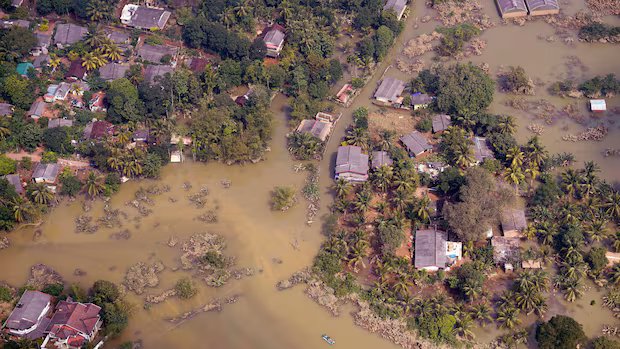
The storms in late November triggered devastating landslides, floods submerged homes and hospitals — and in some areas, whole villages.

The scene in Sri Lanka
Villagers in Mwathura, Sri Lanka, have been searching for survivors and cleaning up the wreckage ever since. Nisankka Kumarage, a resident, said his community got a cyclone warning before it hit the night of Nov. 29; a loud noise woke him up at 2 a.m., but he didn’t see anything unusual.
Later, Kumarage told Reuters, he saw part of the village had completely disappeared in a landslide, burying dozens of people.
“We are still working furiously,” he said.
The WWA analysis calculates that with the impacts of climate warming, the chance of a storm this intense is now once in 30 years. But it was the rain, more than the wind, that caused much of the damage.

Early warnings were issued in Sri Lanka and Indonesia, but many people did not understand the scale of the ensuing storms.
“Tropical cyclones are rare so close to the equator, so it’s not something that we see very often,” said Clare Nullis with the World Meteorological Organization. “It means the impacts are magnified because local communities have got no experience in this.”
In Gampaha, Sri Lanka, 40-year-old Malika Kumari told Reuters, “It rained non-stop for three days. We heard about the flood warnings, but we didn’t expect water levels would get this high.
“Everything is underwater,” he said, standing in floodwaters.
Flooding exceeded historical levels
The cyclone was formed through slow movement over a large part of the North Indian Ocean, carrying heavy moisture with it, said Lalith Rajapakse, an engineering professor at the University of Moratuwa in Sri Lanka, one of the academics involved with the WWA study.
“All this contributed to the huge torrential rainfall, quite unprecedented.”

While flooding in monsoon seasons is expected, Rajapakse said it far exceeded historical levels. In some areas, waters rose four metres so even reaching the second floor could not save people.
Heavy five-day precipitation events are forecast to be between 28 and 160 per cent more intense than in recent decades, according to the WWA findings.
In Sri Lanka, deforestation on hillsides and the urbanization of floodplains meant the storms wreaked havoc in highly populated areas, knocking out bridges and roads, damaging over 277,000 buildings and impacting clean water supplies.
The WWA preliminary assessments suggest Sri Lanka’s economic losses total three to five per cent of the national GDP, or $6 billion US to $7 billion US. Indonesian officials estimate their recovery costs will top $3 billion US.
“This should be an unequivocal eye-opener to the scale of future climate-driven extremes the country and the region must prepare for,” said Rajapakse.