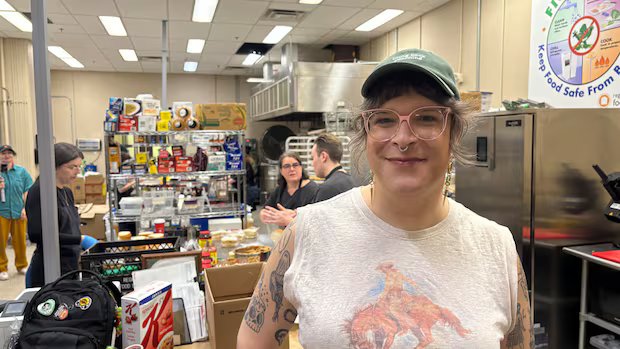
This First Person column is written by an author whose pen name is Carrie Biner and who lives in Regina. For more information about First Person stories, see the FAQ.
“What kind of woman do you think you are?”
I’ll never forget the question my spouse, Courtney, asked me when I first came out to her as transgender. I thought about it every day for the first six months of my transition. The question never stopped twisting uncomfortably in my guts, even as the hormone replacement therapy made my skin softer.
Two years later, on a boiling hot day in August, I found an answer.
I had begun volunteering with The Matriarch’s Collective, a grassroots mutual aid group supported by a diverse group of volunteers. Every Saturday, my friend Alejandra and I would join other volunteers to cook and provide healthy, nutritious meals for people who couldn’t afford to feed themselves or their families.

What kind of woman do you think you are?
The question emerged again like a cartoon thought bubble as Alejandra and I loaded food into the car and drove into Regina’s inner city. That day was my first time attending the weekly food handout held in an abandoned gas station parking lot.
As we started out handing the shopping bags, water bottles and utensils, the savoury aroma of the sausage and potato soup, banana chocolate muffins and fresh baked bannock filled the summer air.
I smiled and made small talk with people who came to our table. They deserve kindness and acknowledgement as well as a meal.
Some of them raised an eyebrow when I handed them food.
What kind of woman do you think you are?

I don’t blame them. I wonder what they must think of me: six feet two, broad-shouldered, tattooed, pierced, with anarcho-punk patches on my sleeveless vest and a thick, curly mullet trailing to my shoulders.
My frame is masculine-appearing until you notice my mascara, tinted lip gloss, and my chest pushing out from under my cropped tank. Those curious enough will look at me, puzzled, unsure of what I am. Then they move on and keep walking. Overwhelmingly, the vibe here is, “Who gives a damn what your gender is when you’re giving out free food?”
I found it comforting.
The first sign that something was off was when I heard voices shouting. I saw a woman staggering down the sidewalk and her body collapse.
Alejandra called out, “Who has Naloxone?”
“I do,” a small voice called out. It belonged to Anna, a young person who’d come to collect a meal.
Alejandra held the unconscious woman on the ground, rubbing her knuckles along the woman’s sternum, while Anna checked for a pulse. No response to the knuckles. Barely any breath. She was overdosing.
I dialed 911, explaining to the dispatcher who I was, and what had happened.
“OK sir,” the dispatcher said. “Remain calm. An ambulance is on their way.”
“I’m not a man. I’m transgender.” I felt silly for correcting the dispatcher at a time like this.
There was a pause on the other end. Brief as a lifetime.
“I’m sorry, ma’am,” the voice said. “Help is on the way.”
Then a moment later: “Ma’am, I’m going to tell you what to do next while you wait.”
As Anna produced a needle from her Naloxone kit to jab in the woman’s thigh, I shouted out the dispatcher’s instructions. Raising my voice always feels uncomfortable to me. Too masculine. But in this moment, it was life and death.
Who gives a damn what your gender is when someone is dying on the sidewalk in front of you?
“She’s breathing now, but barely,” Anna said. “I’m going to give her another shot.”
Anna injected her again. This time, the woman began to shudder back to life. Her first few words were slurred and unintelligible. Then I heard her complain about her ankle, twisted in the fall. Her quiet, strained words were soon overwhelmed by the sirens of the ambulance as it approached.
I ran towards the ambulance to tell the EMTs what had happened.
“Thank you,” they dismissed me. “We’ll take it from here.”
Anna and Alejandra backed off from the woman as the EMTs began to assess her, but she waved them off, refusing care. She took a bag of soup, bannock and muffins before she continued to stumble across the street. She was limping from her injury, but alive.
It was only after she walked away and the ambulance departed that I noticed the hot tears running down from under my glasses. I wasn’t the only one. Most of us were crying.
We hugged each other, as more people helped themselves to what they needed.
“You saved that woman’s life,” I said to Alejandra.
“It was all Anna,” she said, deflecting.

What kind of woman do you think you are?
At that moment, I knew the answer. A woman isn’t defined by the circumstances of her birth or how she was raised, but by what she does and how she shows up in the world.
I’m a woman who shows up on her days off to feed the hungry.
A woman who looks scary, manly and butch, but has a soft heart.
A woman who can shout louder than anyone on a crowded street.
A woman who hugs her friends when they’ve experienced something traumatic.
A woman who texts her wife and friends afterwards to share what had happened.
A woman who needs to learn how to use Naloxone, because she’s here to help.
Biner’s partner, Courtney Bates-Hardy, has written a column about her experience. Read it here:
Do you have a compelling personal story that can bring understanding or help others? We want to hear from you. Here’s more info on how to pitch to us.