
Listen to this article
Estimated 3 minutes
The audio version of this article is generated by AI-based technology. Mispronunciations can occur. We are working with our partners to continually review and improve the results.
Perhaps there’s a crying horse inside us all.
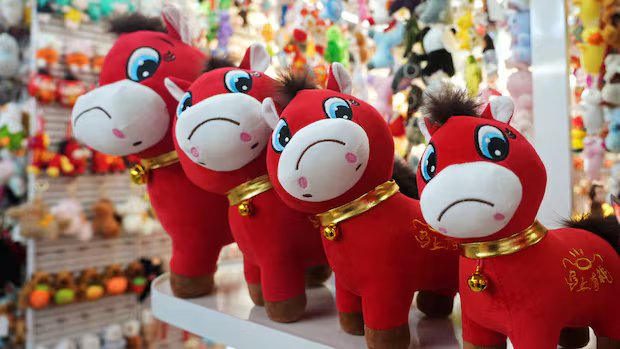
A sad-looking plush toy has become an unlikely, yet not entirely unexpected, bestseller and cultural symbol — despite being the result of a manufacturing mistake.
“Crying horse” is a red stuffed toy designed as a Lunar New Year decoration to mark the upcoming Year of the Horse. It has shy eyes, a little gold bell around its neck, and a fluffy brown mane.
But it’s the accidental frown on its snout that has the toy flying off the shelves in China and trending online. As Zhang Huoqing, owner of the Yiwu-based shop Happy Sister, told Reuters, the horse was designed to be smiling.
But someone made a mistake.
“A worker sewed the mouth on upside down by accident,” she said.
Zhang said she offered a refund after discovering the flaw, but didn’t hear back. Not long after, she discovered photos of it circulating online.

The posts took off. The hashtag #YiwuCryCry-HorseGoneViral had garnered about 100 million views on the social media platform Sina Weibo by Jan. 11, according to the Straits Times.
Now, “crying horse” — sometimes referred to online as “cry-cry horse” — is being upheld as a symbol of the overworked and undervalued. Wang Bin, a professor of social media communication at Renmin University of China, told China Daily he interprets the trend as a psychological response to widespread social fatigue.
“This little horse looks so sad and pitiful, just like the way I feel at work,” a buyer named Tuan Tuan Mami said online, according to the South China Morning Post.
Another commenter named He Qingshan wrote on the Chinese social media platform RedNote that the doll is “healing in a high-pressure society,” according to Business Insider.
Overworked, undervalued
As the South China Morning Post points out, many young people in China call themselves niu ma, a term that means “cattle and horse.” Chinese news site Sixth Tone explains that niu ma has “become a popular online shorthand for China’s overworked, undervalued employees.”
Many Chinese employees are expected to work a 72-hour week under the country’s “996” culture: 9 a.m. to 9 p.m., six days a week. Despite attempts to change that culture, intense overtime has remained a common practice in China.
Enter crying horse, which, according to Business Insider, costs about 25 Chinese yuan, or just under $5. Online, young workers are turning it into memes, posting photos of the horse with captions like, “me when my proposal gets rejected,” says Business Insider.
“People joked that the crying horse is how you look at work, while the smiling one is how you look after work,” Zhang told Reuters.
She reportedly told local media that she’s now receiving tens of thousands of orders for the crying horse every day, and the factory had to add 10 production lines to meet demand. According to the Guardian, wholesale orders for crying horses have come in from Africa, the Middle East and east Asia.
“We will keep selling it,” Zhang told Reuters. “This crying horse really fits the reality of modern working people.”