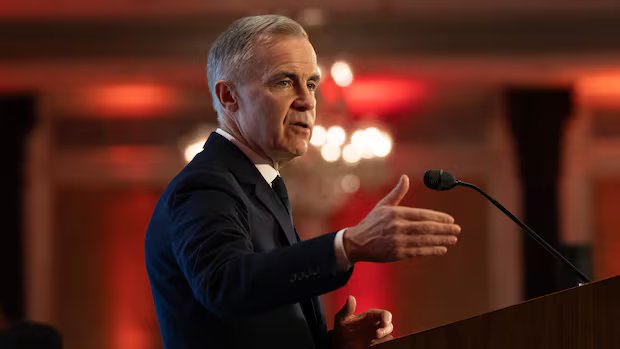
Every prime minister is called upon, at one point or another, to comment on the actions of an American president. For Mark Carney, still less than a year on the job, there have already been several such moments.
The latest moment of necessity arrived this past weekend, when the United States and Israel launched new attacks on Iran.
The response, a six-paragraph statement in the names of Carney and Foreign Affairs Minister Anita Anand, has raised questions with which the prime minister may have to wrestle.
Most of the statement reiterated Canada’s criticism of the Iranian regime. But in the fifth paragraph, Carney and Anand said that “Canada supports the United States acting to prevent Iran from obtaining a nuclear weapon and to prevent its regime from further threatening international peace and security.”
The Australian government offered a similar response, including almost exactly the same expression of support. But a joint statement from the leaders of the United Kingdom, France and Germany did not go that far.
Perhaps there is some ambiguity to mine about what exactly Canada supports. But this weekend’s statement was also notable for how it differed from an earlier one about a previous American action — the January attack on Venezuela and the capture of former Venezuelan president Nicolás Maduro. Carney’s initial three-paragraph response stopped short of expressing support in that case.
Reporters travelling with Carney have not yet had the opportunity to ask him about his weekend statement. But the criticism has come quickly — and from Liberal corners.
A Liberal critique of Carney’s position
In an op-ed published on Saturday, Lloyd Axworthy, a former Liberal foreign affairs minister, compared Carney’s statement on Iran unfavourably to Canada’s decision in 2003 to not support the U.S. invasion of Iraq.
Like that invasion, Axworthy argued the attack on Iran could not be justified under the United Nations Charter, something Carney and Anand’s statement did not address.
“Iran is also not an isolated case,” Axworthy added. “It is the seventh country against which President Trump has ordered unilateral use of force while in office. That should be a blaring alarm for a middle power like Canada.”

Foreign Affairs Minister Anita Anand, who is in India alongside Prime Minister Mark Carney, said Monday that while Canada shares U.S. concerns about Iranian nuclear proliferation, it does not intend to be involved in any military operations and would like to see a diplomatic solution.
Liberal MP Will Greaves expressed similar sentiments in a video posted to social media on Saturday night.
“Canada cannot endorse the unilateral and illegal use of military force, the killing of civilians or the kidnap and assassination of foreign heads of government while also insisting that our sovereignty, our rights and our independence must be respected,” said Greaves, who was a professor of international relations at the University of Victoria before being elected to the House of Commons last year.
In his celebrated speech at the World Economic Forum in January, Carney said Canada would remain “principled in our commitment to fundamental values,” including “the prohibition of the use of force except when consistent with the UN Charter.”
Is this realpolitik in action?
It is probably impossible to avoid speculating about how the imperative to manage Canada-U.S. relations may have influenced Carney’s statement.
Criticizing the American actions wouldn’t have had a material impact on the conflict, says Thomas Juneau, a professor at the University of Ottawa’s graduate school of public and international affairs, but it could have conceivably hurt Canada’s position with Trump.
“For Canada to oppose, to lecture on human rights or on international law would have been costly in the sense that we know that Trump remembers this stuff,” Juneau said.
“It is a crude realist calculus, but that’s the choices that this government is facing.”

Following attacks on Iran by the U.S. and Israel, The National breaks down whether the death of Supreme Leader Ayatollah Ali Khamenei will lead to a regime change. And, what Iranians in Canada are hearing from family members at home.
Asa McKercher, the Steven K. Hudson Research Chair in Canada-U.S. Relations at St. Francis Xavier University, said the United Kingdom, France and Germany are in a different position than Canada, having been parties to the Iran nuclear treaty that U.S. President Donald Trump abandoned.
They are also more likely to be on the front lines of any refugee crisis that results from the war.
As opposed to Carney’s neutral statement on Venezuela, McKercher speculates that the rhetorical support offered on Iran might reflect a sense that the U.S. is entering into a longer and more dangerous conflict.
McKercher also notes that, while Canada did not join the American invasion of Iraq in 2003, the government still moved a motion in the House that expressed the “hope that the U.S.-led coalition accomplishes its mission as quickly as possible with the fewest casualties.”
The foreign minister adds some nuance
In a prepared statement on Monday and later while speaking to reporters in New Delhi, Anand added some context and nuance to the Canadian position.
“First and foremost, Canada wasn’t involved, we weren’t notified and we do not have an intention to be involved in any military strikes or operation,” she said, adding to comments that Carney himself made in India about Canada staying out of the conflict.
The minister emphasized that Canada shares the concern of the United States and others about “Iranian nuclear proliferation,” but then stated a preference for diplomacy.
“This is why I have spent the last two days speaking with my counterparts … stressing that Canada believes in a diplomatic and peaceful solution and as soon as possible we would like parties to get to the table,” she said.
If not a full recalibration of the Canadian position, such comments might at least address some of the gaps.
“I understand why the government is supporting the U.S. and Israel. Iran has long been a menace to the region and to its people, and the prospect of it ever acquiring nuclear weapons is genuinely alarming,” says Roland Paris, director of the graduate school of public and international affairs at the University of Ottawa and a former adviser to Justin Trudeau.
“That said, Trump has still not clearly explained why it was necessary to attack Iran at this moment, when negotiations with a much-weakened Iranian regime were apparently ongoing. So I was struck by what was missing in Carney’s and Anand’s initial statement: namely, any call for a resumption of negotiations to prevent this conflict from escalating and spreading.”
In his own post on the conflict, Bob Rae, Canada’s former ambassador to the United Nations and a former interim leader of the Liberal Party, noted that a desire to bomb Iran is, in some quarters, long-standing. The harder question was what would happen after that.
That sizable unknown might have been a reason to avoid taking a distinct position on the military action. But the uncertain future of this conflict likely means the questions for the Canadian prime minister will persist for some time yet.