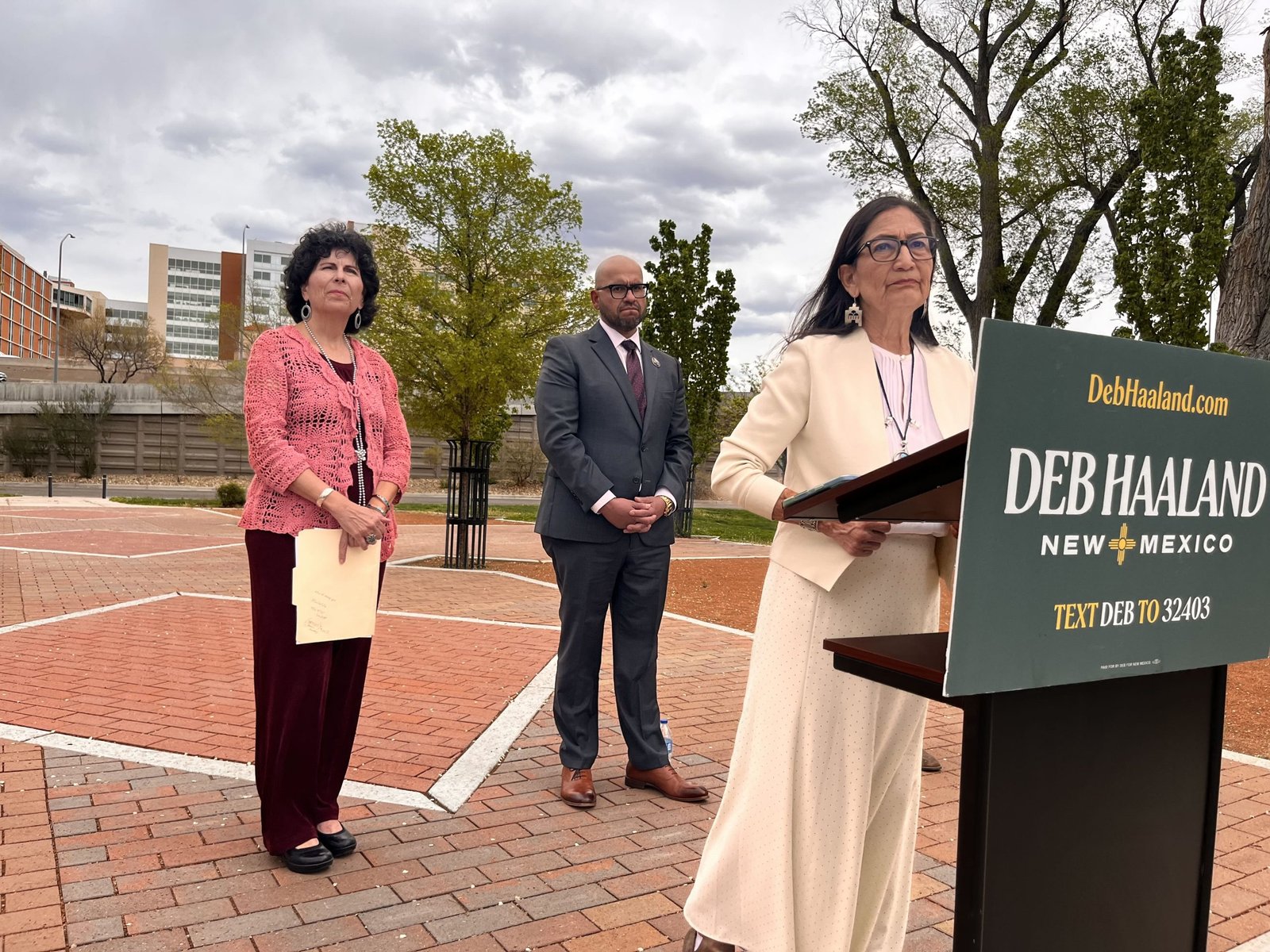
Democratic party candidates to be New Mexico’s next governor have committed to support any remedies, including potential legal action, from an investigation into the forced sterilization of Native American women at hospitals in the state.
“A lot of those actions to sterilize these women happened through the federal (Indian) Health Service, and so those would be actions against the federal government, and I would always be supportive of that,” Deb Haaland (Laguna Pueblo) said. “They were acting on the fact that they were trying to eradicate us from our communities. They acted with malice in every single case, I’m sure, that you can find. I would absolutely support the truth and reconciliation for those actions.”
Haaland made the comments Tuesday after she introduced her health care policy platform that included options to expand public health services, rural hospital investments and incentives to recruit hospital staff.
The platform shared similarities with her Democratic party primary opponent Sam Bregman, pronounced by the reality that the public option is the only option for many in the state. Around 1.2 million New Mexicans, more than half of the state’s population, receive Medicaid, Medicare, or even both options. Both candidates see state investments as one path to cover losses from federal cuts to these budgets, and at the same time, create viable health care services.
Haaland’s remarks about forced sterilization of Native women signaled support for a memorial passed this year by a group of state lawmakers led by Indigenous women and prompted a response from Bregman.
“The forced sterilization of Native American women is one of the most heinous acts ever committed in U.S. history,” Bregman said in a statement to Native News Online. “As governor, I will work closely with the New Mexico tribal community on legal remedy caused by the federal government.”
The memorial passed by the state legislature in February, made New Mexico the first state in the country to formally investigate the scope of the sterilization issues locally. Currently, it is known that these procedures occurred between 1907 and 2018. In the 1970s, a federal report showed that between 25 and 50 percent of Native women nationwide were sterilized without consent.
The memorial directs the New Mexico commission to identify all IHS facilities in the state that conducted these procedures, interview Native women targeted by these actions, compile a review of reproductive health services in the state and offer recommendations for policies to address any inhumane treatment.
The deadline for the report is Dec. 31, 2027, meaning it will be addressed to New Mexico’s next governor.
Democratic party voters, who make up 41 percent of the state’s total voting population, and a growing coalition of those who decline to state a party, will decide June 2 in a semi-open primary between Bregman and Haaland.
If either two are elected governor in the general election, they would support tribes who want to sue the federal government for harm caused from the abusive practice against Native women.
“They did things to people without their consent, without telling them the true repercussions of their actions,” Haaland said. “Just like the tribes who were suing the federal government because they want an accounting on boarding schools, I would support the same for any tribe who would like to sue the federal government for those health care decisions that they made.”
Haaland shared from her recent work as U.S. Secretary of the Interior that led to a published report by a truth and reconciliation commission into federal Indian boarding school policies, as perspective on the time it would take to complete anything close to a remedy for policies that forced Native women into sterilizations.
She said that any actions led by New Mexico’s governor must begin with tribal consultation.
“We worked on the Indian boarding school initiative, it took us nearly four years to complete two reports, and we made a list of recommendations, a few of which might have gotten through,” she said. “This is a big, big undertaking. The federal government is responsible for so many horrible things that happen to Native Americans, that it would be good to highlight that history in every way possible.”