
Listen to this article
Estimated 4 minutes
The audio version of this article is generated by AI-based technology. Mispronunciations can occur. We are working with our partners to continually review and improve the results.
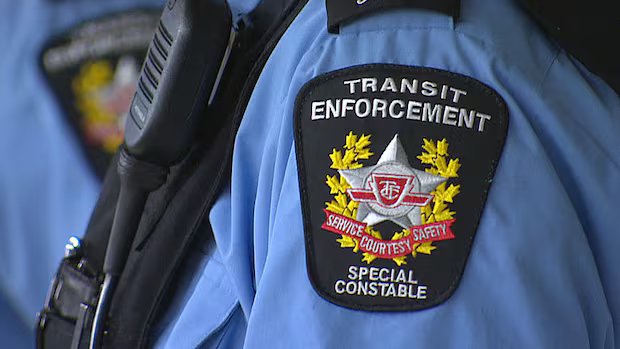
Ontario is considering changes to legislation that could allow special constables to arrest people using drugs on public transit — a move constables say needs to come with an increased ability to use force and advocates say risks further victimizing the most vulnerable.
The change would allow special constables working on transit to direct people to stop using illegal drugs in a public space, arrest and charge people who don’t and take the illicit substances.
The proposed new regulation would be part of a law passed in 2025 meant to prevent public drug use. Members of the public can submit feedback on the proposal until March 1. The special constables who patrol the Toronto Transit Commission are peace officers appointed by the Toronto Police Services Board but do not have firearms, only pepper spray and a baton.
An association representing special constables in Ontario, says the powers have to come with tools to manage volatile situations.
“It could be a very useful tool,” said Sarah Kennedy, president of the Ontario Special Constables Association.
“However, it is putting us in front of people that are unpredictable,” she said. “And they’re putting us in front of them without also giving us the legislation and the tools we need for officer safety and for public safety.”

Commuters may start to see crisis workers around the clock on the “u” portion of the TTC’s Line 1 starting Nov. 15. CBC’s Lane Harrison has the details.
The Ministry of the Solicitor General is looking to make the change “to keep families safe while commuting to work or on their way to school,” according to a statement from spokesperson Saddam Khussain.
Under the act that may be adjusted with the proposed regulation, people can be charged with fines of up to $10,000 or spend six months behind bars.
Constable association worries about risk
Kennedy said her members would be more comfortable with the proposal if they could use something like a Taser.
“The baton is a metal, barbaric beating stick that’s meant to break what it hits. And that’s not lost on us. We don’t want to be out there swinging that baton around. We want a tool that protects distance and a Taser does that,” she said.
Kennedy said if special constables’ powers are expanded by the province, it wouldn’t be automatic — the appointing body would have to give them the permission to use them. In Toronto’s case that would be the Toronto Police Services Board.

There are more than 200 refugees currently staying at the Willowdale Welcome Centre in North York, but they’ll need a new place to stay when it closes at the end of May. The city says it will help, but concerns for their future remain. Talia Ricci reports.
Asked if the board would be interested in letting special constables take on more power, spokesperson Sandy Murray said it would review and consider the regulation once it’s finalized.
Neither the TTC or the office of TTC board chair Coun. Jamaal Myers responded to a request for comment on the proposal.
Advocates say more police not the answer
But Andrew Pulsifer, the executive director of advocacy group TTCriders, doesn’t think it’s something people want to see.
“We’ve spoken with community members and people all across the city who actually feel less safe with more policing on public transit,” he said.
He prefers recent solutions brought forward by city hall, like a pilot to add crisis workers to downtown subways. The Toronto Community Crisis Service was launched by Mayor Olivia Chow in 2024 to resolve mental health calls without police.
Diana Chan McNally, a community worker, said the potential change undermines that work and further criminalizes homelessness.

“It’s scary. It does mean that we will be profiling and targeting people on one of the very few places that they can actually seek shelter,” she said.
Especially in the winter, she said people gravitate towards transit because it’s warm and safe.
The act, which could soon incorporate special constables, already allows officers to direct people to leave a public space if they have “reasonable grounds to believe” they’re using drugs.
“You will see people again find the very few places that they can go,” she said.
“So we’ll see more people in Tim Hortons. It becomes a problem of private business. You see them in libraries, and you’re going to see a lot more people at Union Station. People don’t disappear. I think the province needs to understand this.”