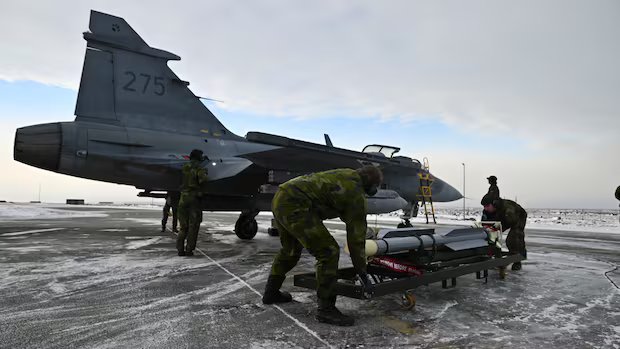
There is a way the U.S. could play hardball with Canada, if the Liberal government of Prime Minister Mark Carney decides it wants to limit its purchase of F-35s in favour of the Gripen.
Critics who favour the Lockheed-Martin stealth fighter have long argued that the Swedish-built Gripen would not be interoperable with American aircraft and the North American Aerospace Defence Command (NORAD).
That’s not what you see at the NATO air policing mission in Iceland, where Danish-owned F-35s have been training and operating alongside Swedish JAS-39 Gripens-Cs.
Commanders of both the Swedish and Danish air forces, speaking at the airfield in Keflavik on Tuesday, said the aircraft have been performing well together.
Part of the reason for that is technical.
The two fighters from different generations speak to each other and share data over a highly sophisticated U.S.-owned system known as Link 16, which contains a cutting-edge anti-jamming and encryption device called a multifunctional information distribution system (MIDS).

The U.S.-built F-35 fighter jet dominated Sweden’s Gripen during a competition held by the Defence Department in 2021. The competitive gap was widest for ‘mission performance’ and ability to upgrade the aircraft over its life cycle.
NOTE: Dave Perry, an expert interviewed for this story, is the president of the Canadian Global Affairs Institute, which gets sponsorship support from defence contractors including Lockheed Martin and Saab.
It is the key for NATO and NORAD interoperability.
And countries wanting to integrate — or stay integrated — with American forces must get permission from the United States to acquire the system.
In this new geopolitical world where everything is weaponized and leveraged, there are concerns the Trump administration is prepared to pull this lever.
The commander of Sweden’s NATO air policing detachment in Iceland acknowledged it was a possibility, perhaps a remote one, when asked if the United States could withhold approval for the encryption terminals from Canadian Gripens.
“If Canada is the first country where the U.S. draws the red card then we have a problem,” said Lt.-Col. Johan Legardt, using the soccer analogy where a red card is shown by the referee to a player who is being sent off the field.
Legardt was quick to add that such a drastic step has never happened in any country where Sweden had sold Gripens in the past.

Trump administration officials have privately said the United States wouldn’t allow highly classified data to be shared over a network where the Gripen fighter was present — a reference to NORAD, the decades-old North American air defence command which Canada and the United States share.
While Washington has not publicly made an explicit threat of withholding the Link 16 terminal from Canadian Gripens, defence expert Rob Huebert wonders if it’s coming — or is lurking somewhere in the background.
“I think that’s always been a possibility,” Huebert said in a recent interview. “Under the Trump era, is anything possible? Absolutely.”

Pete Hoekstra, U.S. President Donald Trump’s ambassador to Canada, warned about potential consequences to the NORAD continental defence pact if Canada doesn’t complete the purchase of 88 F-35 fighter jets and instead buys Sweden’s Gripen jets.
Huebert said he’s uncertain how such a move would play out, but got a whiff of the thinking from the U.S. ambassador to Canada, Pete Hoekstra, who told CBC News in January that if the federal government went ahead with the Gripen purchase, the U.S. would have to buy more F-35s itself and fly more often into Canada to defend the continent.
“NORAD would have to be altered,” Hoekstra said.
One of the reasons the United States might have to do that is because the Gripen was not plugged into NORAD’s secret communications grid.
Huebert said he’s trying to remain hopeful that Canada and the U.S. can settle their differences and get to modernizing NORAD.
“I think the history of NORAD proves that we’ve always been very, we’ve been mature about it,” Huebert said, referring to the long history of co-operation and integration between the two nations. “We’ve been able to figure it out in a way no other countries have been able to do it.”

The federal government has started to make payments for key components for 14 additional U.S.-built F-35 fighter jets, sources have told CBC News. The Department of National Defence says it is reviewing future fighter jet purchases in the context of trade tensions with Washington.
In a recent statement, Saab, the manufacturer of the Gripen, said the question of whether its fighter aircraft was technically able to receive highly classified Five Eyes intelligence was settled back in 2021 when it passed the Canadian government competition evaluation.
“Gripen meets Canada’s interoperability and security needs. This is not up for debate,” said spokesperson Sierra Fullerton, who pointed to how the Gripen, the company’s surveillance aircraft, the Global Eye, and F-35s all exchange data and communications in Europe.
In a separate interview, Jussi Halmetoja, a former combat and test pilot at Saab, said there was no technical reason the Gripen could not communicate on the same level as the F-35 as long as the Link 16 terminal was installed.
He was highly skeptical that the Americans would deliberately blow up their intelligence and defence relationship with Canada.
“They are very keen in keeping — and doing — interoperability, interconnectivity with all the allies, and with Canada,” Halmetoja said. “I find it very, very unlikely. I don’t know it’s ever happened before in 20, 30 years.”
The Carney government has — for almost a year — been reviewing whether to proceed with the full order of F-35s. There are 16 being assembled, with parts on order for more than a dozen additional jets.
Saab, whose Gripen-E finished second in Canada’s fighter jet competition, has renewed its pitch to sell Canada over 70 fighters and has promised to create thousands of manufacturing jobs by assembling the aircraft in the country.
The commander of the Swedish Air Force, in an interview with CBC News in Iceland this week, said critics who have suggested Gripens and F-35s can’t operate together have been proven wrong.
“During our time here at the air policing we have for example co-operated with the Danish F-35s and with German Eurofighter, so we’re doing exercises together in this area,” said Maj.- Gen. Jonas Wikman. “I expect the Gripen-E to be able to integrate in any co-operation when it comes to sensors and sharing information.”
His assessment was echoed by the chief of the Royal Danish Air Force, Maj.-Gen. Jan Dam, who was also in Iceland to observe the NATO mission.
He said interoperability with the Gripens has gone well during training exercises that are part of the Swedish deployment.
“We’ve made each other better and I think that’s what we’re gaining,” Dam said.