
Listen to this article
Estimated 5 minutes
The audio version of this article is generated by text-to-speech, a technology based on artificial intelligence.
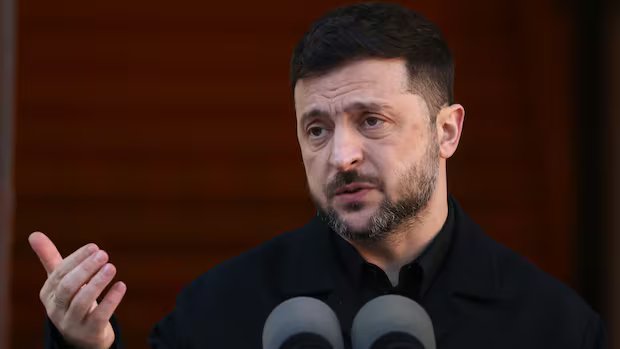
Ukraine President Volodymyr Zelenskyy is set to meet with British, French and German leaders in London on Monday, rallying allies for support as the United States increases pressure on Kyiv to agree to a proposed peace deal with Russia.
French President Emmanuel Macron and German Chancellor Friedrich Merz, who are travelling to London for the meeting hosted by Prime Minister Keir Starmer, voiced their support for Zelenskyy as concerns grow that the U.S. could force Kyiv to accept terms that favour Russia.
“We are starting a new diplomatic week right now — there will be consultations with European leaders,” Zelenskyy told Ukrainians in a video address on Sunday evening, recorded as he was travelling on a train.

A U.S. envoy says territorial claims remain a sticking point in a proposed peace deal between Russia and Ukraine. The U.S.-led meetings have ended; meanwhile, Russia launched a massive strike on central Ukraine early Sunday.
“First and foremost, security issues, support for our resilience and support packages for our defence. First and foremost, air defence and long-term funding for Ukraine. Of course, we will discuss a shared vision and common positions in the negotiations.”
Zelenskyy admitted in a separate social media post that the prospect of peace “depends entirely on Russia.” He will leave London for Brussels, where he will meet later Monday for talks hosted by NATO chief Mark Rutte, with European Union leaders Antonio Costa and Ursula von der Leyen also present.
Days of talks with U.S. negotiators
Ukraine is going through one of the most difficult stages in the nearly four-year war. Russian troops are slowly grinding forward in the east, and Ukrainian cities and towns are plunged into darkness for hours due to intensified Russian strikes on the energy grid and other infrastructure.
Washington proposed a ceasefire plan last month that endorsed many of Russia’s wartime demands. Kyiv’s European allies have since backed Ukraine in seeking to improve the terms.
U.S. President Donald Trump’s envoy Steve Witkoff and son-in-law Jared Kushner brought a revised plan to Moscow last week, then held several days of further talks with Ukrainian officials in Miami, which ended on Saturday with no breakthrough.
Zelenskyy called the discussions constructive but not easy.
U.S. officials said they are in the final stage of reaching an agreement. But there has so far been little sign that either Ukraine or Russia is willing to sign the framework deal drawn up by Trump’s negotiating team.
Trump said on Sunday, prior to hosting honours at the Kennedy Center in Washington, D.C., that he was “disappointed” with Zelenskyy, who Trump said hadn’t read the latest proposed peace deal backed by the U.S. It wasn’t clear what evidence Trump had to support this contention.
Ukraine deserves a dignified peace, and whether there will be peace depends entirely on Russia – on our collective pressure on Russia and on the sound negotiating positions of the United States, Europe, and all our other partners. Russia must be held accountable for what it is… pic.twitter.com/C9pyHxUQw5
After Trump capped his remarkable political comeback last year, which included pledges on the campaign trail to quickly end the Russia-Ukraine war, his approach to Ukraine and Zelenskyy has veered from conciliatory to combative. He accused Kyiv’s leaders late last month of displaying “zero gratitude” for U.S. efforts to end the war and at times has seemed to blame Ukraine for an invasion launched by Russia in February 2022.
During his first presidential term, Trump was impeached in 2019 by the House of Representatives after it was revealed he tried to enlist Zelenskyy, then in his first weeks as Ukraine president, in a scheme to damage Trump’s domestic political rival Joe Biden. Trump was subsequently acquitted by the U.S. Senate.
Trump has criticized Putin on the occasion of Russian military strikes that have killed Ukrainian civilians.
Security strategy makes waves
Trump’s criticism of Zelenskyy came as Russia on Sunday welcomed Trump’s new national security strategy and said it largely accorded with Russia’s own perceptions, the first time that Moscow has so fulsomely praised such a document from its former Cold War foe.
Since Russia’s 2014 annexation of Crimea from Ukraine and its 2022 invasion of its eastern neighbour, U.S. strategies have designated Moscow as an aggressor or a threat that was trying to destabilize the post-Cold War order by force.
The U.S. National Security Strategy is the latest in a series of statements by American officials that have upended postwar assumptions about Europe’s close relationship with its strongest ally, the United States.
European politicians and officials have bridled at Washington’s tone but as they hurry to rebuild their neglected militaries to meet a perceived threat from Russia, they still rely heavily on U.S. military support.
Trump has encouraged Ukraine’s allies to buy weaponry from U.S. arms manufacturers, but has stopped providing billions in military and humanitarian aid provided to Ukraine by the previous Democratic administration led by Joe Biden.

Investments are being made across Europe to shore up its defence capabilities in the face of increased Russian aggression and an uncertain defence alliance with the United States. Andrew Chang explores the steps Europe is taking to deter a possible Russian attack.
Images provided by The Canadian Press, Reuters and Getty Images
The strategy, signed by Trump, also warned that Europe faces “civilizational erasure.”
“Over the long term, it is more than plausible that within a few decades at the latest, certain NATO members will become majority non-European,” the document said. “As such, it is an open question whether they will view their place in the world, or their alliance with the United States, in the same way as those who signed the NATO charter.”
Some European commentators said the document echoed talking points of far-right European political parties, which have grown to become the main opposition to governments in Germany, France and other traditional U.S. allies.