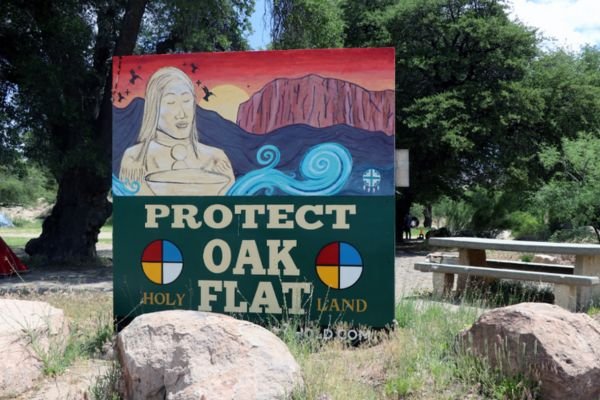
Earlier this month, a decision by a U.S. court of appeals cleared the way for the federal government to sell public lands sacred to tribes in Arizona to a foreign mining company.
The 9th U.S. Circuit Court of Appeals on March 13 denied requests for an injunction to block the transfer of Oak Flat (“Chi’chil Biłdagoteel” in Apache) — a 2,522-acre site in Arizona’s Tonto National Forest that holds ceremonial importance to the Apache people — to Resolution Copper, a subsidiary of multinational mining companies Rio Tinto and BHP. The transfer was finalized on March 16.
The lands are also home to endangered and threatened species, such as ocelots and Arizona hedgehog cacti.
Hours after the March 13 ruling, seven Apache women filed an emergency appeal in the U.S. Supreme Court to stop the transfer, noting that the sale and destruction of the site violates the Religious Freedom Restoration Act. Their plea was denied by Justice Elena Kagan on March 19.
The San Carlos Apache filed a motion last week, on March 26, asking for an en banc appeal from the 9th Circuit, which would form a panel of 11 judges to review the decision.
The ruling and subsequent appeals are the latest in the decades-long legal battle over the land.
Oak Flat was designated public land in 1955 by President Dwight Eisenhower, protecting it from resource extraction, like mining and drilling. The land transfer to Resolution Mining was slipped into the 2014 National Defense Bill.
According to Resolution Copper, the area could yield 40 billion pounds of copper over the next four decades. The company plans to use a technique called panel caving or block caving, removing large swaths of underground rock to form a crater nearly 2 miles wide and 800 — 1,150 feet deep.
Copper is in increasingly high demand as it is considered a critical component to energy technology, like electric vehicles and cooling cables for AI data centers .
Advocates say mining will permanently destroy the site that has been a ceremonial ground to the Western Apache since time immemorial, as well as the habitat of endangered and threatened species, including ocelots and Arizona hedgehog cacti. A public opinion poll conducted by the Center for Biodiversity, released in February, showed that nearly 70% of Arizona voters oppose the mine.
Arizona Congresswoman Adelita S. Grijalva, who introduced a bill in 2025 that would have repealed the 2014 the 2014 National Defense Authorization Act rider, released a statement on March 15 condemning the ruling.
“I am deeply disappointed by this decision, which will allow drilling to immediately begin at Oak Flat — a sacred and irreplaceable place for the Apache people,” Grijalva said. “Oak Flat is not just a piece of land: it is a place of prayer, ceremony, and identity for the Apache people. This site should never have been traded away to foreign mining giants in a backroom deal that ignored Tribal sovereignty, shut the public out of the process, and will destroy vital environmental and critical water resources.”
Apache Stronghold, a nonprofit formed in 2014 to wage the legal fight against the mine, held a spiritual gathering at Oakflat this past weekend. A statement published on Facebook by the organization’s founder, Dr. Wendsler Nosie, Sr. (San Carlos Apache), emphasized the spiritual significance of the area and vowed to continue the fight.
“The legal system may try to reduce our struggle to questions of ownership and profit. But our connection to Mother Earth predates those systems,” the statement read. “It is something each of us is born into, something we carry in our prayers, our songs, and our way of life. No matter what the courts rule, no matter what the government tries to do, we will never stop fighting to preserve our sacred places. We will not lose our connection to the Creator.”