
Listen to this article
Estimated 4 minutes
The audio version of this article is generated by AI-based technology. Mispronunciations can occur. We are working with our partners to continually review and improve the results.
As It Happens5:56Why are basketball shoes so squeaky?
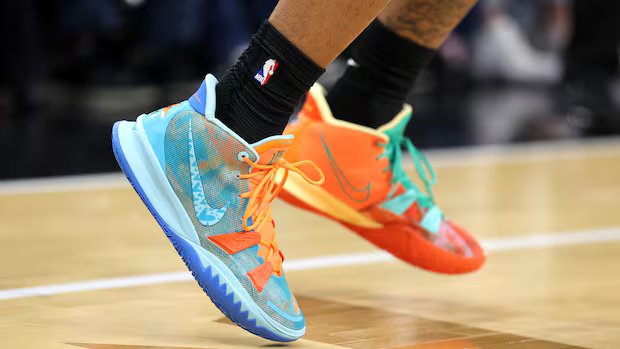
The sound of shoes squeaking against a hardwood court is a given at any basketball game.
But for Adel Djellouli, the noise was something he couldn’t shake as he sat enjoying his first live basketball game.
A newcomer to the U.S., he had gone to see the Boston Celtics in action, hoping to immerse himself in a classic American experience and grow more familiar with the city he had just moved to.
“Probably basketball fans have tuned [it] out, but for me, it was quite striking,” Djellouli told As It Happens host Nil Köksal.
Djellouli is a materials scientist at Harvard University, so rather than ignore the sound, he decided to find out what was making the noise.
The findings were published on Wednesday in the journal Nature.

Built for grip, and noise
Basketball is a sport featuring quick footwork, sudden stops and starts, and explosive jumps.
Court shoes are engineered for precisely these short, powerful bursts of movement. Their rubber soles are designed to provide maximum grip on smooth hardwood, often featuring patterned treads to enhance traction.
For the study, Djellouli and his colleagues used shoes with straight ridges.
In the lab, they repeatedly slid a sneaker against a smooth glass plate. They recorded the squeaks with a microphone and captured the motion with a high-speed camera to observe what was happening beneath the bottom of the shoe.
“We expected something boring … and what we found was something completely unforeseen,” he said.

As the shoe strains to maintain grip, says Djellouli, tiny sections of the rubber sole rapidly change shape, momentarily losing and regaining contact with the floor thousands of times per second. These quick oscillations occur at a frequency that matches the high-pitched squeak heard on the court.
The tread pattern also plays a critical role — something the researchers hadn’t anticipated, says Djellouli.
When they tested a flat piece of rubber, it produced a sound, but not the distinctive squeak. It was more like the noise of ripping open Scotch tape. It was the ridges that gave the shoe the iconic sound.
Bill Wannop, an assistant professor at the University of Calgary who studies athletic performance and footwear and was not involved in the study, says the connection between friction and squeaking has been known for some time. But, he says, this study takes a closer look at the mechanics behind it.
“[It] shows that the squeak is associated with organized elastic waves in the material and that outside geometry, such as ridges, can alter or control that process,” he said.
What else can it tell us?
Rubber is typically soft and slow to respond when slid or rubbed, says Djellouli. Yet his study revealed something more forceful and dynamic.
They discovered a new type of pulse, tiny wrinkle-like disturbances that ripple through the rubber as they make contact with a surface. These wrinkles travel at nearly “supersonic speeds,” he said.
This was surprising because such violent, rapid events are typically associated with earthquakes.
“It’s basically ‘shoequakes’ that we discovered — earthquakes at a different scale,” he said.
“[We] potentially [can] use this kind of knowledge … to understand how earthquake dynamics work and gain a deeper understanding of that.”
One day, says Djellouli, it may be possible to fine-tune shoes to squeak at frequencies too high for humans to hear.
Or, perhaps the sound is inseparable from the sport itself.
“It’s the soundtrack of the NBA and it will be a shame to get rid of it,” he said.