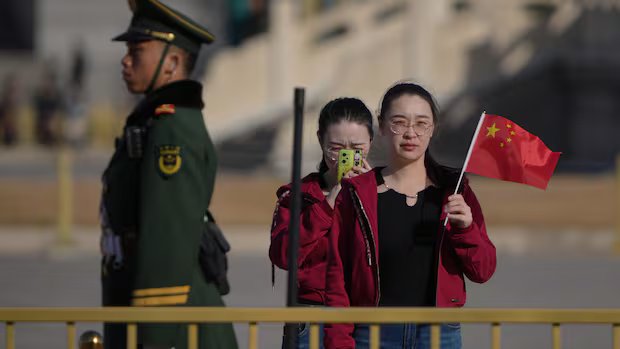
Usually a tourist attraction drawing millions of people a year, Tiananmen Square sits virtually empty, closed off as the Great Hall of the People in Beijing welcomes thousands of delegates from across China for the biggest political parliamentary meetings of the year.
The annual “Two Sessions,” or liang hui, are happening as the country is grappling with a contracting domestic economy and uncertainty as U.S. President Donald Trump wages his tariff war — and as China loses a key ally in the Middle East.
While security in the capital’s downtown area has already been heightened in recent years, there are even more police ahead of the key meetings. Visitors’ faces are scanned at various checkpoints, and officers with sniffer dogs stroll among ornate Spring Festival lanterns and tourists on Qianmen pedestrian street. There is a temporary drone ban in place.
China’s tech push
The Chinese People’s Political Consultative Conference (CPPCC), an advisory body with roughly 2,000 members, will kick off its session on Wednesday, and the country’s legislature, the National People’s Congress (NPC), with its 3,000 delegates, will meet the day after.
These delegates aren’t just politicians. Longtime participants have included the likes of basketball legend Yao Ming and Lei Jun, CEO and founder of consumer electronics company Xiaomi, both in attendance this year. Actor Jackie Chan was once on the CPPCC.
While the meetings are a major platform for policy announcements and communicating economic targets, they’re also a media spectacle reported on by thousands of journalists. On Thursday, Premier Li Qiang is expected to deliver the annual government work report at the NPC — a blueprint for the country’s policy priorities and socioeconomic goals.
Despite the meetings being highly orchestrated, what comes out of them, especially the NPC, will be an indication of where the country is headed — and that has implications globally as China currently dominates in rare earth mineral mining and processing and as the world races toward a higher-tech future. In fact, it has been unabashed in leveraging that dominance in its tariff battle with the United States.
“People will be watching to see where China is placing priority in terms of its economy and social growth,” said Jia Wang, a senior fellow at the University of Alberta’s China Institute.
It is in the Great Hall that the latest five-year plan will be formally adopted. First unveiled in the fall, it foresees China doubling down on self-reliance, including with its own technology in AI and the green energy transition, Wang said.

China is tightening its control over the export of rare earth elements. Andrew Chang unpacks how this move is giving China powerful leverage over the United States. Plus, how and why China is electrifying its economy in the name of oil sovereignty.
A stagnant economy
At the Politburo on Friday, Chinese President Xi Jinping previewed the Two Sessions, with a focus on expanding the economy over the next five years. While these goals could likely headline the meetings, it will be difficult to ignore other questions around the country’s domestic economy.
In part a result of a downturn in its property market, China continues to suffer from low demand. Despite expanding its GDP by five per cent last year, the International Monetary Fund projects 4.5 per cent growth in 2026. In its recent report, it says despite China’s economy proving “resilient in the face of multiple shocks,” it faces increasing challenges.
“[China’s technology focus] is not really a growth strategy per se,” said Logan Wright, partner and director of China markets research at consultancy Rhodium Group, based in Washington, D.C., calling it more of a “security-focused strategy” since these industries don’t “employ many people.”
Wright said China is relying on exports at lower prices as a result of “stagnant” domestic demand, which leads to the overcapacity many countries complain about.
According to the Asia Society Policy Institute, the premier is expected to announce a growth target of 4.5 to five per cent at the NPC, a less ambitious goal than expected. The institute, based in Washington, called the target “another incremental step in the leadership’s long-term shift from high-speed to high-quality growth.”

Iran’s oil exports
Another subject expected to feature at this year’s meetings is the war in Iran. The country is not only an ally, but the majority of its oil is exported to China.
“[Any disruption in the Strait of Hormuz] … will hurt not only China but other countries as well,” said Huiyao Wang, founder of the Center for China and Globalization, a Beijing-based think-tank.
Wang said China has been resilient in the near term, but “long term it could be a problem.”
Xi’s purges
While it won’t outwardly be addressed, journalists and observers will also be looking closely at the seating arrangements at the NPC.
China’s highest-ranked general, Zhang Youxia — currently under investigation — was ousted earlier this year, one of the highest-profile purges following years of Xi’s efforts to clamp down on what the party called “violations of discipline and law.”
“There are a lot of senior military officers … we haven’t seen in a while,” said Dennis Wilder, former CIA deputy assistant director for East Asia and the Pacific. “One of the things we’ll all be doing is try to tally the extent of the purge within the military in the last few months.”
The changes in personnel are said to raise questions about how the army will operate going forward and what it may mean for stability in the region.
Tariff wars and China’s rise
Ultimately, the massive meetings will be a chance to showcase China’s strengths, said the University of Alberta’s Wang. After all, it would appear at this point that Beijing has weathered Trump’s trade war fairly well.
“They believe they … came up as the winner of that rivalry,” she said.
To that point, the Two Sessions will be happening after a parade of world leaders met with Xi in the last few months, including Prime Minister Mark Carney. Trump himself is set to land in Beijing in a few weeks.