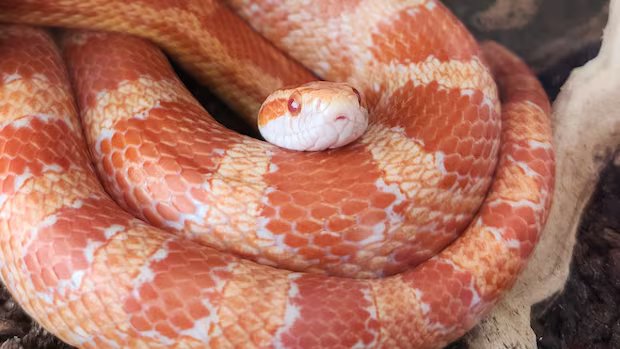
A house filled with snakes and spiders might be straight out of many people’s nightmares, but to longtime exotic pet keeper Nolan Asplund, they’re like family.
“Exotic animals, and animals as a whole, have taken up my entire life,” said Asplund, who has more than 70 reptiles, amphibians and arachnids in his care.
The 17-year-old aspiring zoologist operates Funky Fresh Reptiles, an exotic pet business headquartered in his parents’ house in the Calgary bedroom community of Okotoks.
He’s got everything from leopard geckos and Santa Isabel poison dart frogs to a Brazilian rainbow boa and ball python — not to mention Asian forest scorpions, a camel spider and more than a dozen tarantulas.

He’s far from the only reptile fanatic in the area: Alberta’s exotic pet community — particularly in Calgary and surrounding area — has been “growing exponentially” in recent years, Asplund said.
Calgary has cemented itself as one of Canada’s exotic pet hot spots, with the city being home to major events like the Western Canadian Reptile Expo and Calgary Reptile Expo, both of which bring in thousands of attendees.

Cody Faulds, president of the Alberta Reptile and Amphibian Society, said the city’s exotic pet community has been “growing steadily.” Attendance at the group’s events, including the Calgary Reptile Expo, has been increasing, and more people are reaching out for information on keeping exotic pets.
Faulds — who owns multiple reptiles, including three box turtles and four snakes — attributes the hobby’s increasing popularity to multiple factors.
“It’s getting easier and easier to get into,” he said.

Faulds said the exotic pet hobby has come a long way since the Alberta Reptile and Amphibian Society began in 1984.
“Forty years ago, you basically pulled an animal from the wild, and nobody had any idea how to make the animal healthy and happy living in captivity,” Faulds said. “Now there’s more people, more breeders sharing that information.”
More pet stores are stocking a greater variety of exotic pets, and more landlords are allowing them to be kept on the premises, Faulds said.
“I’m very happy and hopeful that the trend keeps increasing,” Faulds said. “More people see this as not a scary, dangerous animal, and more of something that you can have in your family.”
Exotic pet ownership remains controversial
Organizations like the Canadian Veterinary Medical Association have voiced opposition to the keeping of many exotic animals as pets.
Tracy Fisher, the association’s president, said that doesn’t necessarily apply to certain animals that have become common in many Canadian households.
“They pose very minimal risk to people and to other species, and so things like the little ball pythons, corn snakes, bearded dragons … would fall under that category,” she said.
“However, we have a number of other species that don’t fall under that category, such as venomous snakes [and] very large snakes that might pose a risk to people.”
Exotic pet ownership legality varies across Canada, with most laws governed by municipalities and provinces rather than the federal government.
In Alberta, a lengthy list of “controlled species” bars many reptiles from being kept as pets, including snapping turtles, alligators and crocodiles, and venomous lizards. More types of snakes are prohibited in the province than any other animal, including anacondas and all species of cobra, viper and sea snake, as well as the Central African rock python, which in 2013 was responsible for the deaths of two boys in New Brunswick.
Fisher, who works as a veterinarian in Regina, has been seeing more of what she called “non-traditional pets” as patients.
“I get people coming for hours to see me because they don’t have a veterinarian locally who’s comfortable seeing reptiles,” she said.
Another thing to consider with exotic pet ownership is complex care requirements and lifespans — turtles, tortoises and certain tarantulas, for instance, can live for decades.
Fisher pointed to chameleons as an example.
“They are almost impossible to keep alive in captivity unless you have these misting systems and these complex aquariums and temperature controls, and special food and vitamins,” she said. “You have to think about all of those things before you go into it, and really be honest about your own limitations about being able to care for it.”
Exotic pets deserve more love, keeper says
Beyond just keeping exotic pets, Asplund is also involved in educating people about them. He said there are many misconceptions and stigmas about the hobby.
Asplund said the shy and reclusive nature of many exotic pets is a clear sign they’re not looking to harm anybody.

“I’ll walk into my reptile room and all of my tarantulas immediately will just hide,” he said. “They’re not going to come and attack us or anything of the sort. That’s just not in their nature. Through Hollywood movies, though, that’s been portrayed, and it’s just not true.”
There are no recorded instances of tarantula venom killing anybody, in the wild or in captivity. The most commonly-owned snakes — corn snakes and ball pythons — are non-venomous and docile.
“I feel like when people come to the realization that these animals are not out to hurt us, we are in turn able to give them the respect that they deserve,” Asplund said.