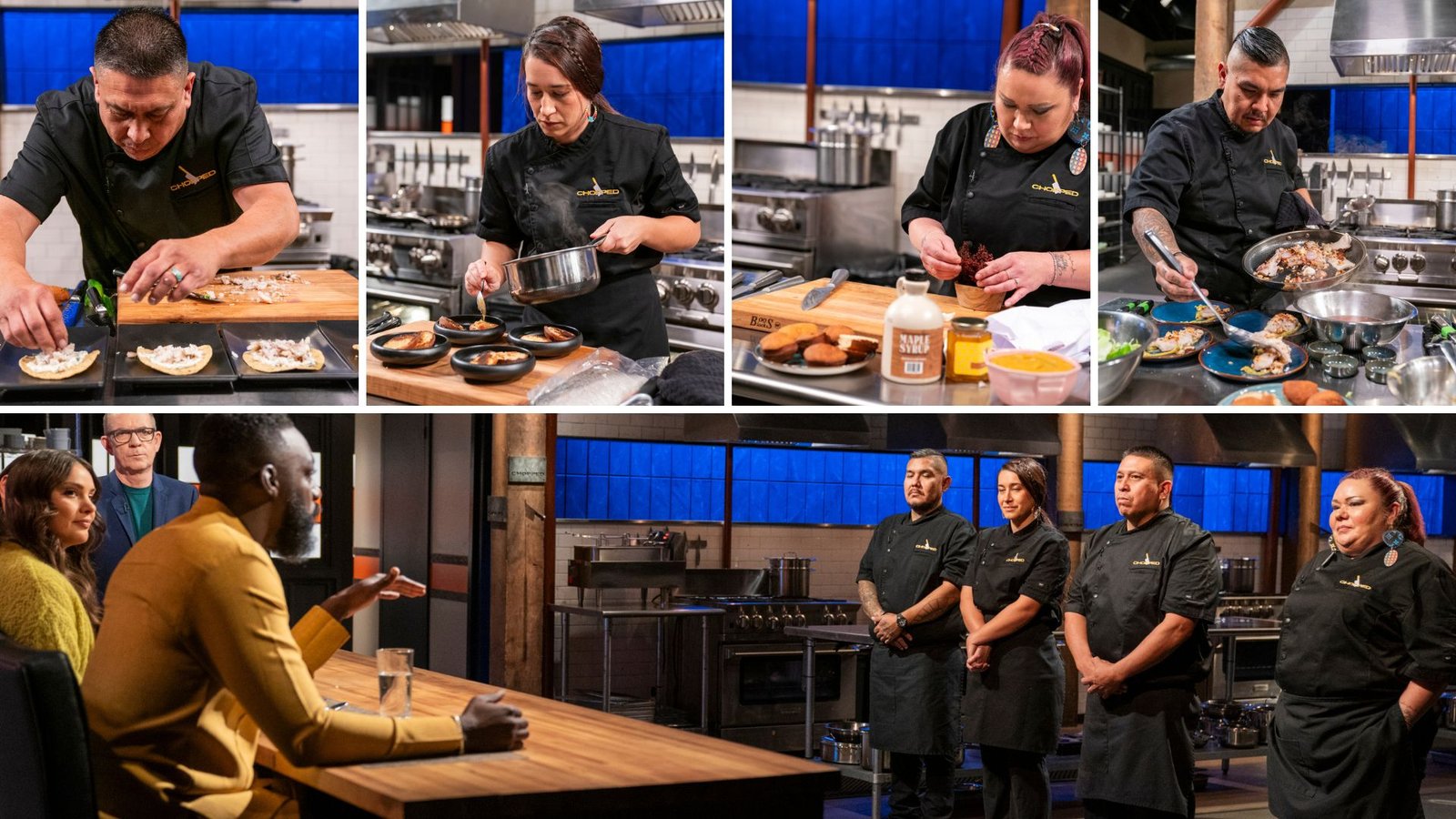
On a New York City pier, Justin Pioche had a surprise run-in with friend and fellow Native American chef Ray Naranjo that provided a major reveal.
It wasn’t a typical day for Pioche. The Navajo chef said he flew into the city and was directed to an undisclosed warehouse where he would be filmed as a competitor in a new episode of “Chopped” that premieres April 21 at 9pm ET/PT on the Food Network.
“My buddy Ray comes walking around the corner while they’re filming me.” Pioche inquired. “What are you doing here?”
Pioche finished the question to his friend from Santa Clara Pueblo and the two Indigenous chefs instantly made the connection.
“It clicked in both our heads. ‘Oh, we’re going against each other.’ So we just smiled and waved at each other, gave each other a hug,” Pioche described. “Then the producers were like, ‘oh, no, you’re not supposed to be here. Ray, go over there, go over there.’”
The moment of kinship pushed ahead the film schedule on-set “Chopped” the cooking competition show that has aired 64 seasons on the Food Network since 2009, and for the first time this week will showcase Indigenous Food Sovereignty as the main ingredient across an entire competition.
Competitors include Pioche (Navajo), Naranjo (Santa Clara Pueblo), Jessica Walks First (Menominee) and Mariah Gladstone (Blackfeet, Cherokee). Judges include Eric Adjepong, Pyet DeSpein (Prairie Band Potawatomi) and Sean Sherman (Oglala Lakota Sioux).
“Every basket is packed with ingredients known and loved in Native communities, like sumac and whitefish for the first round,” Food Network producers for the episode shared. “The judges look forward to tasting entrées featuring a lean, tasty protein.”
There is a deeper prominence inspired from the episode that grows beyond the ingredients that the chefs used.
“Food has always been medicine, and I think that we need to keep it that way because medicine can be more than just nourishment, it can be some sort of a way to heal yourself,” Pioche said. “I mean, as Natives we all celebrate food. We all laugh around it, we cry, we celebrate, we mourn. It brings us together.”
Pioche, who runs Pioche Food Group with his sister and mother, shared a few details on how he approached competing on the show against familiar people from the tight-knit Indigenous Food Sovereignty scene.
“Each of us has our own style. I was raised in fine dining and so that’s just always in the top of my head. So don’t be afraid to push the envelope, but don’t get too crazy. So that was my approach, to use somewhat familiar flavor profiles and also cooking procedures,” he said.
Naranjo set the tone about the significance that the chefs had to showcase their work in the kitchen and how it reflects their roles within Indigenous communities.
“Ray got us all together beforehand and we all did a little pep talk,” Pioche said. “No matter who wins or no matter who loses, you got to always make sure that we use our voices for good and then for our communities. We all agreed. There were no hard feelings whatsoever between any of us, whether we won or lost.”