Fresh statistics show a sharp nationwide drop in violent crime in major U.S. cities in 2025, and U.S. President Donald Trump is claiming that his get-tough policies are the reason.
The decreases are as dramatic as they are widespread, reported in all broad categories of violent crimes and seen in cities of all sizes and political leanings across the country.
The most stunning statistic in the new 2025 violent crime report from the Major Cities Chiefs Association is the 19.3 per cent drop in homicides averaged across the 67 largest cities in the U.S.
If that figure is reflected when the FBI publishes its annual national report on crime statistics, it will be the largest single-year reduction in U.S. homicide numbers on record and will bring the country’s murder rate down to a level not seen since the early 1900s, according to the non-partisan Council on Criminal Justice.
The downward trend in violent crime is so across-the-board that it defies any simplistic explanation of why it’s happening. That isn’t stopping the Trump administration from claiming credit.
“This is the direct result of President Trump’s aggressive, no-nonsense approach to public safety,” the White House declared in a news release citing the statistics.

“President Trump’s decisive actions have turned the tide,” the White House said, attributing the drop in violent crime to “surging federal resources to Democrat-run cities that had devolved into war zones” and to “removing savage criminal illegals from our streets.”
The inconvenient truth for the Trump administration is that violent crime was already in sharp decline before he returned to office in early 2025, and last year’s sharp drop also happened in cities that saw neither “surging federal resources” nor concentrated immigration crackdowns.
‘Something much bigger’
“It’s something much bigger and larger that’s going on,” said Thaddeus Johnson, a senior fellow at the Council on Criminal Justice and an assistant professor of criminal justice and criminology at Georgia State University.
“No one entity can claim credit,” Johnson, who served in law enforcement in Memphis, Tenn., before becoming an academic, told CBC News.

Among the notable examples in the major cities report, the number of homicides in 2025 were down 32 per cent year-over-year in Washington, D.C., where Trump sent in the National Guard last summer. Homicides were down by a nearly identical 31 per cent in nearby Baltimore, where the president did not deploy troops.
Significant reductions in homicides were reported in major cities in blue states, like Chicago (down 29 per cent) and Los Angeles (19 per cent), which were the subject of notable federal immigration sweeps.
But homicides were also down in big cities in red states — such as Dallas (23 per cent) and Tampa (53 per cent) — as well as cities in swing states, for example Philadelphia (18 per cent) and Phoenix (14 per cent), which have not been the focus of Trump’s crackdown.
Despite Trump’s demonization of undocumented immigrants as violent criminals, there’s a vast body of research showing crime rates among immigrants are lower than among people born in the U.S.
Additionally, the declines in violent crime predate Trump’s return to the White House.
Year-over-year reductions in homicides were also reported by the Major Cities Chiefs Association during the Biden administration, in 2024 (down 16.4 per cent), 2023 (down 10.4 per cent) and 2022 (down 5.1 per cent) following the pandemic-driven surge in homicides that began in 2020, the final year of Trump’s first term.
So what really is driving the drop in crime? Various experts say there’s a range of reasons.
‘There never is a one thing’
Alex Piquero, a professor of criminology at the University of Miami and the former director of the U.S. Bureau of Justice Statistics, points to examples of cities that invested in fixing streetlights, parks and dilapidated buildings to make neighbourhoods safer, or “community violence interruptor” programs in which ex-offenders work directly with at-risk youth to keep them away from crime.
“Everybody wants to know the ‘one thing,’ and there never is a ‘one thing,’ ” said Piquero. “We have a lot of things that we know work.”

There’s a broad consensus among experts that the steepness of the decline can in part be attributed to the natural fall-off from the spike in violence seen during the first two years of the COVID-19 pandemic — a spike which was itself seen as an off-shoot of the complex mix of school closures, shuttered community programs, social isolation, fewer police patrols and an overburdened court system.
Anna Harvey, a political science professor and director of the Public Safety Lab at New York University, says there are two broad categories of interventions that reduce crime: measures that increase the likelihood of detection and interventions that target those most at risk of committing crimes.
“What happened during COVID is that the bottom fell out from both of those,” Harvey said in an interview. “You lost everything that was helping to keep violent crime down, and that happened on a nationwide scale.”
Big post-pandemic investment in cities
Then, after pandemic restrictions lifted, U.S. cities got what Harvey describes as “an extraordinary level of reinvestment” from the Biden administration, largely through its American Rescue Plan Act, with billions of dollars pumped into public safety, housing, infrastructure and community programs.
“There are many plausible explanations for the recent crime downturn: sharper policing strategy, more police overtime, low unemployment, the lure of digital life, the post-pandemic return to normalcy,” wrote Henry Grabar in The Atlantic last month.
But only the Biden-administration investments match the scope and scale of the drop in violent crime, he argued.
There are a few caveats that prompt the experts to warn Americans against prematurely celebrating the trend.
While the statistics show violent crime is down across the country, the national averages hide the reality that Black communities remain disproportionately affected.
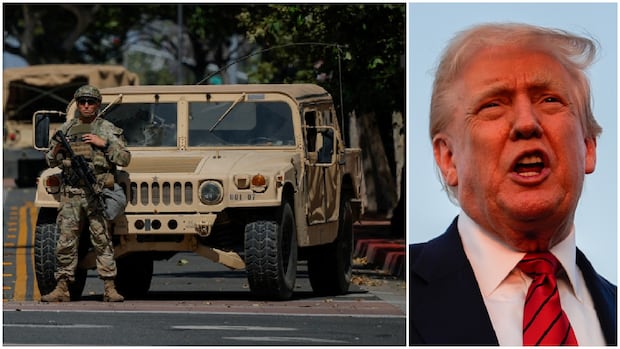
U.S. President Donald Trump announced at a Tuesday news conference that he will send the National Guard to Chicago. The announcement, part of Trump’s continuing threats to expand federal law enforcement across the country, came the day after a U.S. federal judge blocked the Trump administration from using the military to fight crime in California.
Crime remains high in certain neighbourhoods
“No one can make me believe that one or two years of investment is going to offset generations of victimization and offending in particular neighbourhoods,” said Johnson of Georgia State.
Harvey of NYU is wary that attention to the national trend means that certain areas where crime persist could get ignored.
“For the neighbourhoods that are where this violence is most concentrated, it’s still quite high,” she said.
Although the broad classes of violent crime all showed sharp decreases in the 2025 Major Cities Chiefs report — with robbery down 20 per cent, aggravated assault down 10 per cent and rape down nine per cent — Harvey points out that one key category is on the rise: domestic violence.
There’s also concern that the crime-reduction trend won’t necessarily continue.

Whether it’s politicians, police or violence-prevention program officials, Piquero says people are quick to claim credit when crime numbers go down, but will not be so quick to take responsibility if the numbers go back up.
“Now is not the time to take our foot off of the intervention and prevention pedal,” Piquero said.
“The U.S. still has a violent crime problem vis-a-vis places like Canada and the U.K. and Australia,” he said. “But we’re moving in the direction that we all want to be moving in.”
Johnson says police, government and communities must keep doing the things that have worked to lower violence.
“Right now we may just have a lull of sorts,” he said. “If we feel like the battle is over and won, we’re fooling ourselves.”