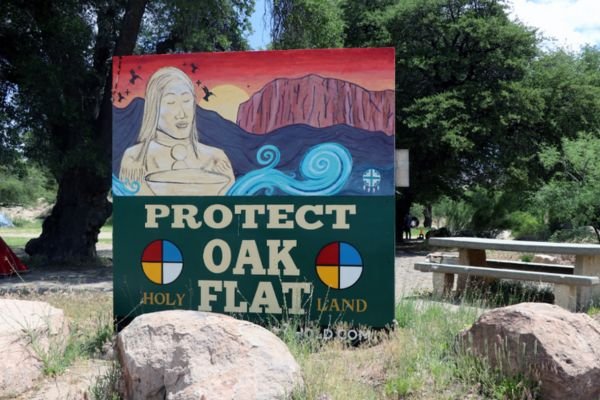
Tribal advocates, conservation groups, faith leaders and community organizations are calling on Arizona Gov. Katie Hobbs to halt plans that would convert thousands of acres of state trust land into a massive dumping ground for mine waste tied to the proposed Resolution Copper project.
In a coordinated push, opponents urged the governor to prevent the auction and development of land in Dripping Springs Valley, identified as the site for a tailings storage facility that would hold nearly 1.4 billion tons of mining waste. The facility would support the proposed copper mine east of Phoenix, a project that would ultimately destroy Oak Flat, a site sacred to Native American communities.
“Gov. Hobbs has the power to stop Arizona from being used as a dumping ground for toxic mine waste and we need her to use it before it’s too late. The governor can make sure our state isn’t complicit in Oak Flat’s destruction,” said Russ McSpadden, Southwest conservation advocate at the Center for Biological Diversity. “These state lands are supposed to serve the public and future generations, not expose people and wild places to long-term risk. Arizonans deserve better.”
According to the U.S. Forest Service’s final environmental impact statement, the proposed tailings facility—known as Skunk Camp—would span more than 9,200 acres, or roughly 14 square miles, making it one of the largest in the world. The site would store toxic mining byproducts containing heavy metals such as lead and arsenic, held behind a dam rising nearly 500 feet.
“The Forest Service’s own analysis says the Skunk Camp tailings facility would harm people nearby, including Tribal communities and many lower-income, rural and Latino communities in the region,” said Henry Muñoz, a retired underground miner and member of Retired Miners Concerned Citizens in Superior, Arizona. “A tailings failure would contaminate the Gila River Basin all the way to Phoenix and hurt Arizonans and the environment for generations.”
Opponents also argue the plan conflicts with Arizona’s legal obligations for managing state trust lands. The Arizona State Land Department has determined the facility would reduce surrounding land values, raising concerns about whether the project serves the best interests of trust beneficiaries, including public schools.
“Arizonans would bear the environmental risks, water depletion and long-term liabilities of this project, while foreign investors reap the profits,” the groups wrote in a letter to Hobbs. “Your Administration has the authority to protect Arizona families and preserve the integrity of state trust lands by rejecting this dangerous mine tailings facility proposal.”
“Arizona’s state trust lands are held in trust to generate long-term value for schools and other beneficiaries, and that responsibility requires careful, forward-looking stewardship,” said Sandy Bahr, director of the Sierra Club’s Grand Canyon Chapter. “Approving a massive toxic tailings facility that would devalue surrounding lands and create lasting environmental liabilities is incompatible with the State Land Department’s fiduciary duty. State leaders have both the authority and the obligation to ensure these lands are managed in a way that protects their value and avoids shifting long-term risks onto future generations, including the school children who are trust beneficiaries.”
The controversy is closely tied to Oak Flat, a place of deep cultural and spiritual significance that is listed on the National Register of Historic Places as a traditional cultural property. Known as Chí’chil Biłdagoteel, the area remains central to the religious practices and identity of Western Apache and other Tribal nations.
“Don’t mine what can’t be remade — protect Oak Flat,” said Selena Lamas (Akimel O’odham), a member of the Brophy Xavier Native American Club, Class of 2028. “Some places are more than resources; they hold history, culture and life that can’t be replaced once they’re gone. When land like this is destroyed, it isn’t just nature that’s lost, but a part of identity and legacy that future generations will never get back.”
Resolution Copper plans to use block-cave mining to extract ore deep underground, a method expected to cause the surface at Oak Flat to collapse into a crater nearly two miles wide and more than 1,000 feet deep. The operation would also require significant groundwater pumping—enough, critics say, to supply the city of Tempe for decades—raising additional concerns about regional water availability.
If approved, the project would transport billions of tons of waste through pipelines to the Skunk Camp site, transforming thousands of acres of state trust land into a long-term storage facility for toxic tailings—an outcome opponents say would have lasting consequences for communities, ecosystems and future generations.