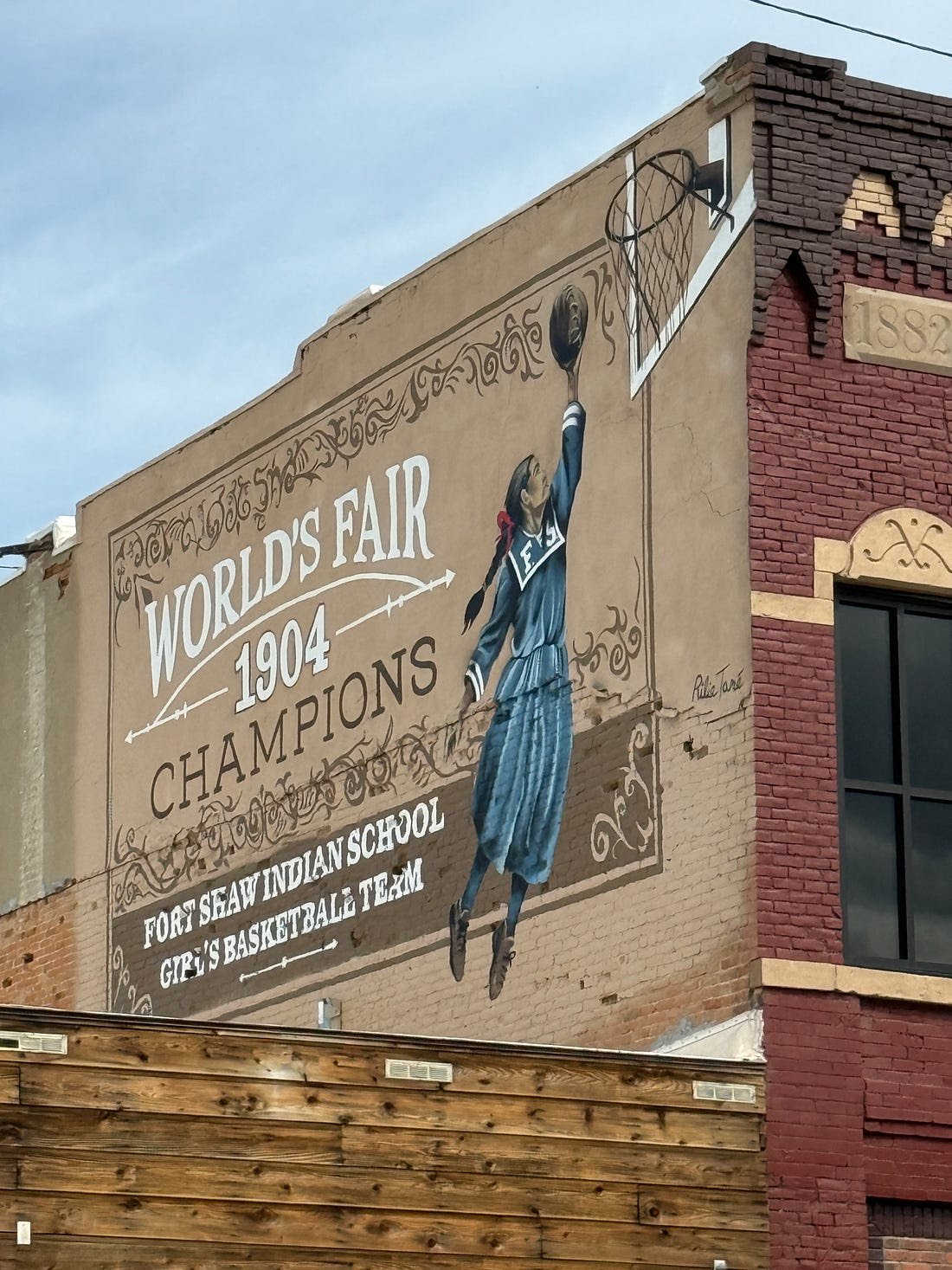
The community of Fort Benton, Montana, honored the legacy of the 1904 Fort Shaw girls basketball team Tuesday. There was an unveiling of a mural at the Benton Pharmacy. The second floor of that building was used as a basketball court — and it may be the only structure that’s still around where the girls played. It’s small, dark, rectangle room. (Imagine what it must have been like when with a crowd and a game being played.)
The team started playing the game in 1902. A year later they had developed a reputation for their team work and their speed. They defeated college and high school teams and along the way a state championship.
Then in 1904 the team traveled by train to the Louisiana Purchase Exposition in St. Louis, today known as the world’s fair. (The event was supposed to celebrate the 1803 Louisiana Purchase, but was behind schedule.)

I grew up with the story. My grandmother would from time to time pull out pictures of her family, and the Fort Shaw girls team, including her Aunt Genie Butch.
One of those pictures was her mother, Josephine, her brother as a baby, and her Aunt Genie at a train stop. Genie Butch, Assiniboine, was really dressed up in the styles of the day — and I always imagined that this photo was her headed for the world’s fair. (But I don’t know the date of the photograph, so that is only speculation, but Walter Clark Jr. was born in 1900 and he would have been around four in this photo.)
Back to the story. The girls spent five months at the world’s fair as students in a Model Indian School. They were on display. Dancing. playing music. And, of course, taking on all challengers in the game of basketball. On the basketball court they had no peers. As the play unfolded, they eventually played a St. Louis all-star team for the championship and won the first match by a score of 24-2. Then a rematch, another lopsided score, and the team was crowned of World Champions.
There is more to this history. There’s an excellent book is by Linda Peavy and Ursala Smith, Full-Court Quest: The Girls from Fort Shaw Indian School, Basketball Champions of the World. And Montana PBS produced a fabulous documentary, Playing for the World.
Fort Shaw’s girls championship is story worth telling often.

Why Fort Shaw’s story is important
I see the Fort Shaw story as a foundation story. A canon story. (A canon story, or a master narrative, is a story told often so that it becomes one we all understand. It’s sort of like human software, part of our operating system.) Think about this arc. The Fort Shaw girls begin he 20th century with a fancy new sport, basketball. It’s like learning a new technology, a way of thinking. Then this Indian girls team take that sport and creates excellence on the court. They were better than good, they were the best team in the world.
Basketball today is still a defining sport. It’s played in gyms across Indian country. Or on hard dirt in front of a house. The legendary speed and precision of the Fort Shaw girls is still part of the game, run and gun.
Minnie Burton, Shoshone-Bannock, who ended up at Fort Hall, Idaho, was the team’s star and so popular that fans would shout, “Shoot! Minnie shoot!”
We don’t have enough stories about excellence in Indian Country. Stories are told all the time about poverty, social ills, or even those narratives about great wealth that is generated from oil or casinos. (Tragedy was also part of Fort Shaw’s story. These girls, including my relative, faced the evils of their time and especially violence against women.)
But their mission on the court: pursuit of craft, and the discipline that requires, remains an essential lesson for us all.
There is another story that I think important— and it goes beyond Indian Country — and that’s the importance of women’s sports. Think about this moment and the remarkable interest in a game played by women and girls. Basketball was new (and the rules were often proscribed to limit girls on the court.) But what if that championship moment had become permanent? What if Fort Shaw’s narrative did not end up in family albums but became a theme about equity in sports? That’s why the 1904 story still matters; it’s is a story that still needs to be told.