
Opinion
With the recent controversies surrounding the iconic John F. Kennedy Center for the Performing Arts, I found myself thinking about a special evening I spent there with Native Americans from across Indian Country on July 1, 2022.
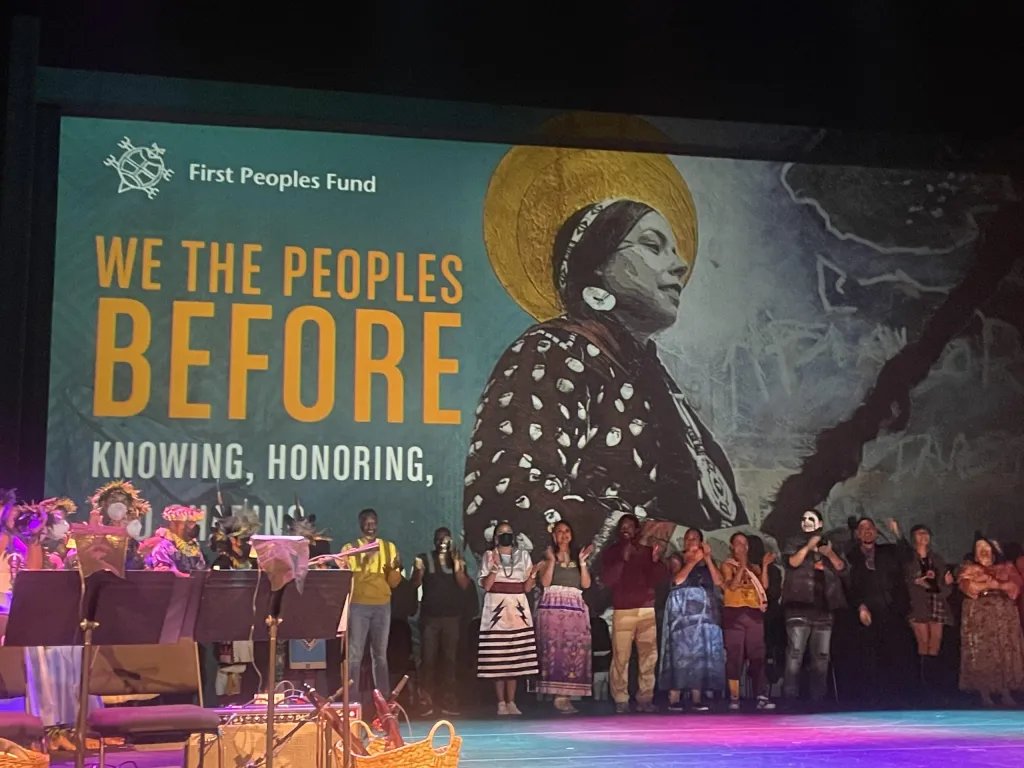
Before a sold-out audience of more than 1,150 people at the Kennedy Center’s Eisenhower Theater, dozens of Native American actors, dancers, singers, and other artists came together for a two-hour performance called We The Peoples Before.
Presented by the First Peoples Fund and the Kennedy Center, the event brought more than 50 Native performers to the stage. Among them were Joy Harjo (Muscogee Creek Nation), Supaman (Apsaalooke Nation) and Pura Fé Crescioni (Tuscarora/Taino).
The production was a spectacular display of Native American talent that mixed narrative, song and dance. It told historical stories of purposeful attempts to destroy Native peoples through genocide and the systematic stripping of this continent’s Indigenous peoples of their land, language, and culture.
For those of us in the audience, it was more than a performance. It was a powerful expression of Native creativity, culture, and presence in the heart of the nation’s capital.
National Center for American Indian Enterprise Development board member Ron Solimon (Laguna Pueblo) traveled with his wife from Albuquerque, N.M., for the festival.
“Last night’s performance was just simply sensational,” Solimon told Native News Online the next day. “The performance left me feeling bubbly. The diversity of culture, all the singing, and the other kinds of talent that was expressed there was fabulous.”
Shannon Martin (Gun Lake Tribe) accompanied her elderly parents to the Kennedy Center from Michigan. Martin, a consultant and former director of the Ziibiwing Center of Anishinabe Culture and Lifeways in Mount Pleasant, Mich., said the production invoked the resilience of our people by revisiting where we come from and understanding the hardship and the adversity we have lived through.
“The eclectic body of work highlighted both our traditional storytelling lifeways to the contemporary, dynamic storytelling of our youth through slam poetry and hip hop lyrics. For me, the feeling of sitting in the middle of the room, the Eisenhower Theater at the Kennedy Center, surrounded by black and brown people, was just amazing,” Martin said.
I was there covering the performance for Native News Online. While there, I recalled touring the Kennedy Center as a teen during a spring break trip with my family. We were in awe then of the majestic building that was built as a memorial to the young president assassinated on a street in Dallas.
President Dwight Eisenhower signed legislation in 1958 that established a national cultural center in Washington, D.C. The legislation called for the federal government to partially fund the center. By the time Kennedy succeeded Eisenhower, private funding of the center had come to an almost stop. Kennedy established in 1962 a fundraising campaign to raise $30 million.
During an event to raise funds for the National Cultural Center, President Kennedy said, “Art knows no national boundaries. Genius can speak in any tongue, and the entire world will hear it and listen…I am certain that after the dust of centuries has passed over our cities, we, too, will be remembered, not for victories or defeats in battle or in politics but for our contribution to the human spirit.”
After Kennedy was assassinated, President Lyndon B. Johnson signed legislation renaming the center the John F. Kennedy Center for the Performing Arts as a living memorial to Kennedy, who loved the arts.
Since its opening in September 1971, the center has served audiences through 10 presidencies, including President Donald Trump.
Along comes Trump, who now wants his name on the building that was intended to memorialize a slain president. Since assuming office for his second term Trump has packed the Kennedy Center’s board of trustees with close allies, who named him the chairman of the board. On December 19, 2025, Trump’s name was physically installed on the exterior marble facade of the Kennedy Center.
Rep. Joyce Beatty (D-OH), who serves on the Kennedy Center’s board of trustees in an ex officio capacity as a member of Congress, filed a lawsuit soon thereafter. She won an initial ruling when U.S. District Judge Christopher Cooper ordered the removal of Trump’s name from the building. Judge Cooper said putting Trump’s name on the building violated federal law.

Workers removed his name in June. In September, Cooper blocked another attempt to put it on the building.
Even with the court ruling, Trump persists in trying to have his name put on the memorial to President Kennedy. Now, Trump is threatening to demolish the Kennedy Center if he cannot put his name on the building. The American people must recognize we have a president who acts recklessly with no sense of history. He tore down the White House’s East Wing without approval.
What is next? Can he demolish the Lincoln Memorial? Can he bulldoze the Washington Monument?
Congress gave the Kennedy Center its name by law. Congress should do its job and tell Trump a resounding no to demolishing it.
The Kennedy Center is a venue for all Americans. The electrifying night four years proved that for me as I watched We The Peoples Before.
Thayék gde nwéndëmen – We are all related.
The post I Saw Native Artists Fill the Kennedy Center. Now Its Future Is in Doubt. appeared first on Native News Online.