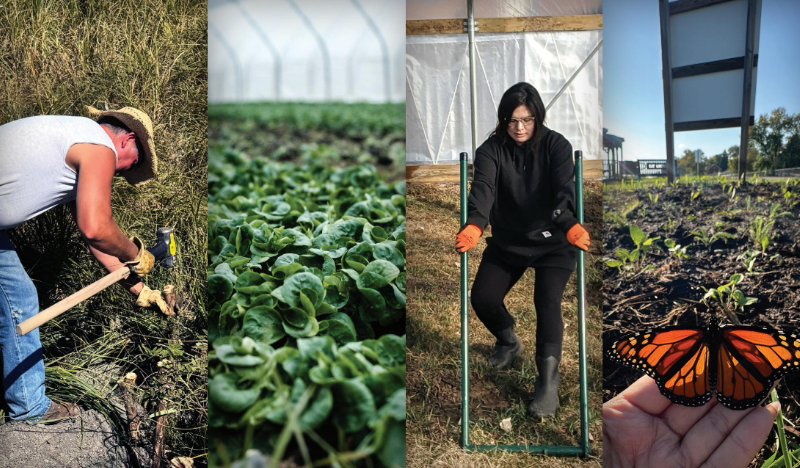
The American Indian College Fund has released a new publication, “Caring for Our Kin: Stories of Indigenous Environmental Stewardship,” highlighting the work and perspectives of seven Indigenous environmental leaders. Designed as a guidebook for Native students and community members, the publication offers insight into how Indigenous knowledge systems and community-based approaches can shape the future of environmental stewardship.
The guide was developed through the College Fund’s Tiyata Wan Unkagapi (We Are Making a Home) Environmental Stewardship Program, which supports environmental science and natural resource programs at tribal colleges across the Northern Great Plains.
“Caring for Our Kin” emphasizes that effective stewardship requires a holistic, community-centered approach, rooted in relationships between people, land, and culture. The stories presented in the guide illustrate the diverse ways Indigenous leaders are addressing environmental challenges while strengthening cultural continuity.
Among those featured is Adriann Killsnight He’heenóhká’e (Blackbirdwoman) of the Northern Cheyenne Nation, who integrates cultural values into wildlife management. Early in her academic journey, she struggled to translate the spiritual depth of Cheyenne concepts into English, an experience that shaped her approach to communication and collaboration. Today, she views stewardship as inherently relational, understanding animals, plants, water, and soil as relatives carrying cultural and historical knowledge.
Ayanna Maynard of the Cheyenne River Sioux Tribe works at the intersection of ecological restoration, cultural revitalization, and education. Her commitment to mentorship and community-driven learning led her to pursue dual degrees in sustainable agriculture and business. She emphasizes that technical expertise must be paired with practical knowledge, particularly in growing food and medicine while sustaining economic opportunities.
Foster Cournoyer Hogan of the Rosebud Sioux Tribe focuses on bison revitalization efforts across tribal nations. Originally on a pre-med track, Hogan shifted his path after recognizing a broader need for community healing. His work is grounded in relational accountability and acknowledges the emotional and structural complexities of Indigenous conservation work.
Nick Hernandez of the Oglala Sioux Tribe combines Western academic frameworks with Indigenous values to develop community-led food systems and workforce initiatives. His long-term vision centers on “generational abundance,” where Indigenous youth can thrive professionally without sacrificing cultural identity.
Shaun Grassel of the Lower Brule Sioux Tribe has dedicated his career to grassland restoration and wildlife conservation on his homelands. With advanced degrees tailored to tribal priorities, Grassel advocates for systemic change that allows tribal nations to lead conservation efforts from the outset. His work reflects a commitment to scaling local impact through broader institutional influence.
Teri Harper of the Cherokee Nation emphasizes that conservation is both a guiding principle and a profession. She established an internship program at Aaniiih Nakoda College’s Buffalo Research and Education Center, grounded in the belief that Indigenous knowledge must be integrated into scientific spaces. For Harper, understanding science begins with lived experience.
Zach Ducheneaux of the Cheyenne River Sioux Tribe draws on personal and historical experiences, including the 1980s farm financial crisis, to inform his work in building equitable economic systems for Native communities. His approach incorporates lessons from horsemanship—such as partnership, observation, and empathy—into leadership and investment strategies aimed at long-term sustainability.
Together, the leaders featured in “Caring for Our Kin” demonstrate that Indigenous environmental stewardship is not a single practice but a dynamic, interconnected approach rooted in culture, community, and responsibility to future generations.