Miss something this week? Don’t panic. The CBC’s Marketplace rounds up the consumer and health news you need.
Want this in your inbox? Get the Marketplace newsletter every Friday.
How grocery giants control who can sell food in your neighbourhood

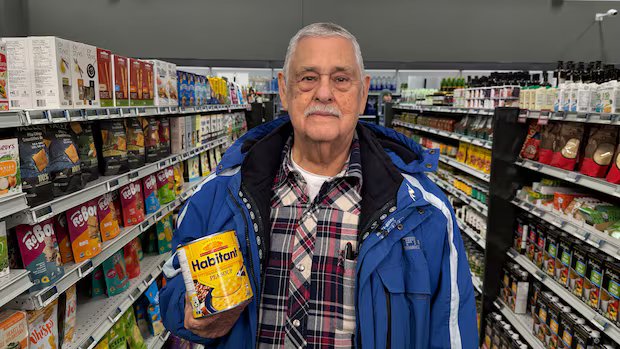
Dave Lawson is a proud Canadian, with bumper stickers that say “Canada is not for sale.” He’s fed up with grocery products plastered with maple leaves and patriotic logos that turn out to be U.S. imports.
It’s called maple washing, and it’s on store shelves across the country.
“It’s kind of disappointing when you actually look at some of the so-called Canadian brands … Not a lot of them are made in Canada. So it’s like, ‘OK, why are we doing this? Let’s do better,'” the St. Catharines, Ont., man told the CBC’s Marketplace.
This past week, U.S. President Donald Trump made his latest tariff threats against Canada. Prime Minister Mark Carney renewed the push to “Buy Canadian” and posted a video online reiterating that the government will do the same in the projects it is supporting around the country.
Lawson is part of a Facebook group dedicated to buying Canadian, especially given calls to keep “elbows up” in response to the U.S. trade war. For him and many others, that means picking products that are made here, with Canadian ingredients.
One item that frustrates him is Betty Crocker’s chocolate chip cookie mix. The front of the package has a maple leaf and the words “Canada’s #1 Selling Baking Mix Brand.” But when you flip it over, it says, “Product of USA.”
“This is advertising trying to make it look Canadian, when in reality, it’s not,” Lawson said.
Marketplace put the cookie mix and some other popular food labels to the test, and found that on patriotic packaging, the truth can be buried on the back, where it’s easy to miss.
The packaging is “at the very least confusing, but I would argue misleading, as well,” said Mike von Massow, a food economics professor at the University of Guelph.
Marketplace asked General Mills, the company behind the Betty Crocker cookie mix, about its label. In a statement, the company said it highlights “Canada’s #1 Selling Baking Mix Brand” because it’s true, based on sales, that the label is not new and reflects the pride they have “in being a part of the kitchens all across Canada.”
Read more from Marketplace journalists Rosa Marchitelli, Stephanie Kampf and Bobby Hristova.
Disabled man feels shut out of accessible seating as venues — including Rogers Arena — fail to stop abuse

A B.C. man who uses a wheelchair to attend hockey games and concerts tells CBC’s Go Public major venues and Ticketmaster have not done enough to ensure accessible seats are going to those who need them.
A Langley, B.C., man who often relies on a wheelchair says he can rarely attend hockey games or concerts at Rogers Arena in Vancouver because accessible seats are often taken by people who might not need them.
After a 2006 car accident, Michael Coss suffered a traumatic brain injury and spent six months in a coma. Despite daily physical therapy, he is at high risk of falling and uses a walker or wheelchair. He lives in a group home and says leisure activities are essential.
“It’s important for me to have a sense of normalcy,” said Coss. “To be able to enjoy simple things. Life can’t just be about rehab.”
The accessible sections at Rogers Arena might be considered prime seating. They’re designed for people to manoeuvre wheelchairs and other mobility devices, so there’s plenty of legroom. There is also just one row of seating, so others aren’t squeezing by to get to their seats, and chairs can be pulled up for attendants or family and friends of those with disabilities. There’s often a ledge that provides a convenient spot for food and drinks.
Major venues across the country sell these designated accessible seats on the honour system — people simply have to tick a box saying they need the seats, and there’s no proof required.
Coss says that’s leading to abuse by many people he sees sitting in the section.
“No wheelchair. No cane,” he said. “That section should be for people with a physical or cognitive disability.”
Canucks Sports & Entertainment, which owns the arena, told Go Public the venue uses an approach that upholds “the privacy and dignity of all fans” and that because some disabilities may not be formally documented, their goal is to be “respectful, fair and inclusive.”
The spokesperson also said the seating is not limited to guests who use wheelchairs, despite a sign outside the section that explicitly states the area is for people requiring mobility aids.
“These spaces support fans who may be recovering from injuries, have difficulty navigating stairs, experience anxiety or mobility limitations, or live with temporary or invisible disabilities,” the spokesperson wrote.
Advocates say Coss’s experience reflects a broader problem: Those who abuse the system are shutting out people who actually need the seats, and nobody — including venues, ticket sellers or the government — is stepping up to solve the problem.
Read more from Go Public’s Erica Johnson and Ana Komnenic.
P.E.I. couple says their kids’ RESP is in limbo because the bank altered their last name

Max Deller-Lestage and Marie Pascal are frustrated with the service they’ve been getting from a bank. For more than a year, they haven’t been able to move their investments because of a problem with how their name was entered on their account. CBC’s Laura Meader explains.
What’s in a name? A lot, apparently, as one Prince Edward Island family found out.
Max Deller-Lestage and his wife, Marie Pascal, opened a registered education savings plan (RESP) at TD Bank for their two children, aged three and seven.
The children use a combination of their parents’ last names, resulting in the surname of Pascal Deller-Lestage. But while filling out a digital form for the RESP, there wasn’t enough space for such a long name.
The couple said the bank opted to remove the hyphen and a space from the name so it would fit — and that’s where the problems began.
The family later wanted to move the RESP, which holds around $6,000, to a different bank that offered better interest. The transfer wouldn’t go through, however, because the new bank included the hyphen and the space in the kids’ last name.
The couple’s attempt to change the name on the TD account didn’t work because the name field was still too small.
More than a year later, Deller-Lestage and Pascal still haven’t been able to transfer the funds to the new bank.
“The issue could have been escalated to somebody who could fix the problem, because the local branches didn’t know what to do,” Deller-Lestage said.
“Every time I would explain to them the situation, they would sort of kick it down the road and ask to get back to me in 10 days, two weeks, a month.”
No one with TD was available for an interview, but a statement sent to CBC News said the bank is looking into the issue and that it’s “prioritizing remediation as soon as possible.”
Read more from the CBC’s Lucas McInnis.
What else is going on?
Carney announces food affordability measures, including boost to GST rebate
Measures include $500 million in capital investment funding for food businesses, $20 million for food banks
Recall of Pizza Pops expands due to possible links to E. coli outbreak
Recall includes three-cheese, pepperoni, pepperoni and bacon, deluxe and 3-meat varieties
TikTok settles landmark lawsuit over youth addiction claims
Meta, Instagram also facing claims their platforms deliberately addict, harm children
Millions of Canadian homes have high levels of cancer-causing radon. Is yours one of them?
Recent building code update mandates radon mitigation in new houses, but many existing homes still at risk
Why solving cold case killings just got much harder for police
Genetic genealogy investigations hampered by Ancestry.com search ban
Marketplace needs your help!

Have you complained to the consumer protection office in your province or territory? If so, we want to know how it went. Email us at marketplace@cbc.ca.
Catch up on past episodes of Marketplace on CBC Gem.