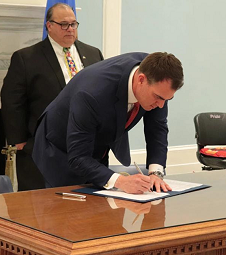
Republican Oklahoma Gov. Kevin Stitt, a tribal citizen of the Cherokee Nation, has moved to eliminate the state’s Native American Education Council, arguing the body is unnecessary and ineffective—a decision that is drawing concern from Tribal leaders and education advocates.
Stitt recently issued a veto that could discontinue the council, describing it as “redundant” and criticizing its infrequent meeting schedule. The council, established to help improve educational outcomes for Native students and ensure Tribal perspectives are included in state education policy, has served as a formal avenue for collaboration between Tribal nations and state officials.
The governor’s office contends that the council duplicates efforts already underway within the Oklahoma State Department of Education and other entities, suggesting its responsibilities can be absorbed elsewhere. Stitt also pointed to the council’s limited number of meetings as evidence that it is not fulfilling a meaningful role.
But critics say the move overlooks the importance of dedicated Tribal representation in education policymaking—especially in a state that is home to 39 federally recognized Tribal nations.
Advocates argue that the council provides a unique forum for addressing disparities that disproportionately affect Native students, including lower graduation rates, underfunded schools in Tribal communities, and the need for culturally relevant curriculum.
The council has also played a role in supporting Native language preservation efforts and advising on the implementation of Tribal history and culture standards in Oklahoma classrooms—an issue that has gained prominence in recent years.
Opponents of the veto warn that eliminating the council could weaken government-to-government relationships between the state and Tribal nations, at a time when collaboration is increasingly important in areas like education, health, and economic development.
They also note that infrequent meetings may reflect broader challenges—such as limited funding or administrative support—rather than a lack of need.
The veto now places the future of the Native American Education Council in uncertainty, with lawmakers and Tribal leaders weighing next steps. Some are expected to push for an override or alternative measures to preserve a formal mechanism for Tribal input in education policy.