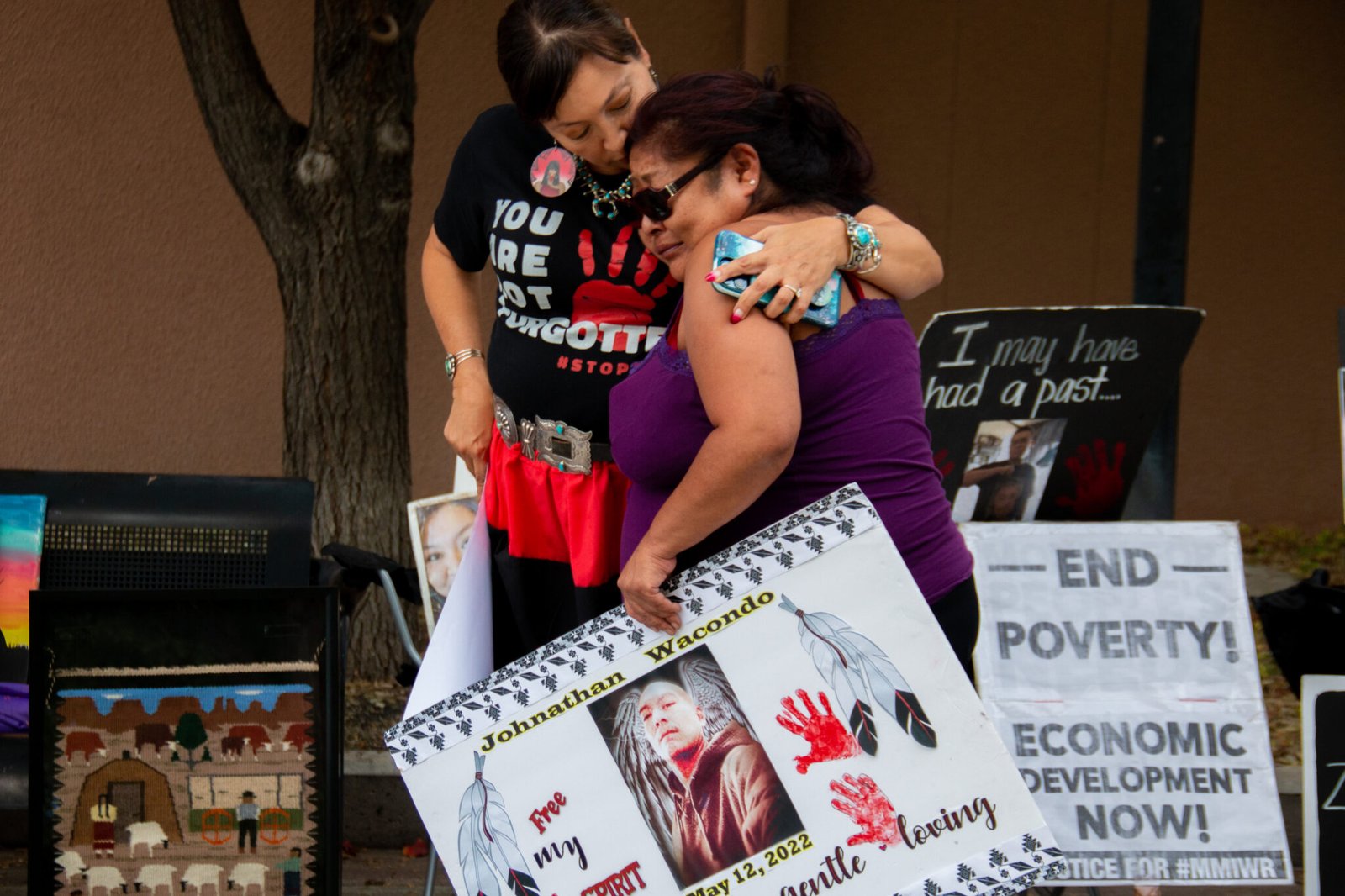
In 26 years, attorney Darlene Gomez has worked with 33 Native Americans families desperate for support and answers for their missing or murdered loved ones. In that time she said that her clients saw justice served with criminal prosecutions on eight cases.
“It’s almost surreal,” Gomez said. “Because all I can think about is the time and energy that this family has put in to get a guilty verdict and all of the other families that are still waiting for their justice.”
Gomez, who grew up and has a home on the Jicarilla Apache Nation, provides legal and advocacy support directly to families who find themselves personally affected, and helps them navigate the Missing and Murdered Indigenous Women and Relatives (MMIWR) crisis network. Even as the acronym has shifted for official use by law enforcement and funding sources to Missing and Murdered Indigenous People (MMIP), it all leads to the same conclusion that in order for violence to end against Native American people in the United States there must be institutional support and accountability.
Gomez spoke with Native News Online before she went to participate in the national Missing and Murdered Indigenous Peoples Awareness Day that now occurs every year on May 5.
She talked about what is working, what needs to be done and offered advice on how tribal leaders can step up to help the missing and murdered get the justice they deserve.
“It makes me think there is hope,” she said, describing the reaction when families hear a guilty verdict. “That we do live in a country where justice is possible.”
This interview has been edited for clarity.
Native News Online: From your view, what’s the status of the MMIP/MMIWR crisis in 2026?
Darlene Gomez: 2026 looks very similar to the past 10 years. What we’re seeing today are the same issues that have been a part of the crisis of MMIWR. We are seeing law enforcement not having enough training to put together prosecutable cases. We are seeing the FBI continue to put minimal resources into Indian Country. Indian Country is still considered a hardship for FBI agents, so we get a lot of brand new agents, agents with very little experience investigating the most heinous crimes under the Major Crimes Act.
With that being said, even our FBI agents are not doing an adequate job, just like in the Ella Mae Begay case. There was a confession that was taken without (the suspect) being Mirandized, which was Preston Tolth. Which virtually made the Ella Mae Begay case fall apart.
We still see the lack of funding for our tribal police who are oftentimes the first ones on the scene. They are virtually the most important piece of getting a case prosecuted in any court. And with them, they lack the training. Our tribal police are not competitive with city police or state police anywhere. There’s this lack of housing for them. There’s this lack of training.
It has this domino effect on families.
NNO: You mentioned Ella Mae Begay, you worked with the family to elevate that into a high-profile case. Can you share the latest?
DG: Yes, I worked on the Ella Mae Begay case for about two and a half years. Currently, I’m not their attorney. About a month ago, the U.S. Attorney’s Office (for Arizona) entered into a plea agreement and a sentencing agreement with Preston Tolth. At that time, the judge did not take the plea. At that time, I had spoken to the Associated Press, and I said, I believe the U.S. Attorney’s Office is going to come back with another fabulous plea, and Preston Tolth was going to take it.
What really bothers me in this case, is the fact that this plea agreement that has been offered to Preston Tolth completely takes off a homicide or manslaughter charge.
We know Preston Tolth has said he violently beat Ella Mae Begay who at the time was a 62-year-old Navajo rug weaver, and he disposed of her on either the side of the road or on a dirt road. So virtually, he could go free after doing three years in jail. That was the initial plea that the judge rejected. Now we have another plea in front of the judge, which is not that much better of a plea for the family.
What’s also interesting is so many cases in the U.S. Attorney’s Office are not even taken to trial. Of all the cases that get formally submitted to the U.S. Attorney’s Office, 70% are declined. Out of the 70% that are declined, the statistics kind of show anywhere between 90 and 96% are pled out.
In the Ella Mae Begay case, they should have taken it to trial because that’s what the family wanted. They would rather roll the dice and see what a jury would convict or not convict Preston Tolth, rather than give him a sweet plea deal, and then he is out running amongst the people on the Navajo Nation.
It really frustrates me because I think when the U.S. Attorney’s Office take and give pleas, they never think, would that plea be acceptable to their own families? Because so many of the U.S. Attorneys do not live on reservations. So it’s really not their problem. They give sweet plea deals, the perpetrator gets out, and then re-perpetuate on Native communities.
NNO: From your view where are tribal governments succeeding in their response to the MMIWR crisis?
DG: Tribal governments are now stepping up to the plate and offering reward money for MMIWR cases.
I currently have a case out of Rapid City, South Dakota, Sahela “Toka Win” Sangrait who was murdered by a Ellsworth Air Force Base airman, and the Cheyenne River Sioux Tribe gave money to help me fly to Rapid City and help with the costs associated with family support.
I see other tribes like the Jicarilla Apache Nation, who said, ‘Hey, we support the families who are victims of MMIP, MMIWR, then we will do a letter of support encouraging the FBI, U.S. Attorney, and police agencies to do their due diligence.’
We also have the Navajo Nation President Buu Nygren, who has committed money to the MMIWR crisis through lots of different plans from community planning to Amber Alert systems, to more money going into domestic violence services, and really expanding all of the bottom line issues that also affect people becoming victims of MMIWR.
I do think the National Congress of American Indians should band together and request Congress to enforce an audit on the FBI and the U.S. Attorney’s Office.
But also individual tribes should encourage and demand that the FBI put rewards on every single case in Indian Country. What we see is when rewards are offered in Indian Country, they’re much less in dollar value than the rewards offered for white people.
NNO: Do you see any other areas where there needs to be improvement for tribal governments?
DG: One, really put funding towards having MMIWR organizations within their tribe to offer boots on the ground services for the families of the missing and murdered.
It can be as simple as also paying for all of the missing persons posters that go out, giving them to the family for free. Using social media to post the pictures of the tribal members that are missing. They can also put their own reward money up to solve cases just like the Sac and Fox Nation did for the Brandon Kaseca Sr. case. They put up their own money for reward money.
It can also be as simple as going to the family and trying to have monthly meetings with a family member every three months to give them encouragement to ask them, how can I help you ?
There’s just so many little things that tribes and Pueblos can do to make the families feel better and to also demand due diligence from all the law enforcement agencies working in Indian Country.
NNO: Have you noticed any disruption to MMIWR/MMIP cases under recent FBI reorganization and staff reductions?
DG: The issue with the FBI is they have never, ever been transparent. I have cases that are under the jurisdiction of the FBI, and I have not heard from the agent in two years.
The mere fact that the data that comes out of the FBI is very minimal and not transparent, there is no way for everyday people to know what is going on internally, when agents are leaving, when agents are coming. Even with Operation Not Forgotten, it is said through the FBI press release that at least 200 cases have been resolved.
I would like to know out of those 200 cases, what stages were they in?
Were they cases that were already going to be solved, and they just had to turn them into the U.S. Attorney’s Office? Were they cold cases? Were they cases where someone was reported missing, but then found?
We have no reliable data.
That’s where the auditing of the FBI should occur by Congress and should be demanded by leaders in Indian Country.
NNO: For families that may be reading this who are going unheard about their missing or murdered loved ones, whether it’s through community or law enforcement. What is the first thing they should do to improve their situation?
DG: Number one, always document all of the phone calls and emails that you send to law enforcement. Number two, you are the voice for your families. Be loud. Be the loudest person in the room. Share your story anytime there is a tribal council meeting, when there is a city council meeting. At any kind of task force meetings.
Number three, social media is your best friend. Make sure you disseminate the missing person flyers or the murdered flyers out into Facebook, TikTok, Instagram, and then also reach out to the media and send them a press packet saying, ‘hey, this is my loved one. They were loved.’
They deserve a place in the media. Continue to push them, have positive relationships with the media sources in your area and also cold call national media sources like CNN, NBC, Fox News, keep sending them those press packets. Keep reminding them that your loved one is missing.
I always love the idea of buying T- shirts with your loved one’s picture on it and any information about when they went missing or when they were murdered. Because when your community sees that, then a lot of times tips come out of that.
Go to your tribal leadership, ask for reward money, go to your police officers working the case law enforcement, ask them for reward money. Be the biggest pain in the ass that you can be to law enforcement. Because the person who continues to push and push those cases tend to move to the front of the line.
Try to get your tribe or Pueblo to do billboards, because billboards do work.
Reach out to other families who have had justice, like the Jamie Yazzie family. They always want people to call them so they can encourage them and give them tips.
The hard part also is the fundraising. You have to fundraise to make posters to make T-shirts.
And the families of the murdered and missing are oftentimes working poor, and they go without paying their rent, paying for utilities. They often have bare tires. They’re searching for their loved ones alone because there’s virtually no help for the missing. Everything comes out of the family’s pocket.
So I think one of the things that people always ask me, like, how can I help?
Give a family money for Walmart so they can have food for their searches. Give them gas cards, give them a copier and printer so they can print their own flyers, give them a cricket phone so they can make their own calls, or just share their posters and send them a word of encouragement because so many families feel alone in this conquest.