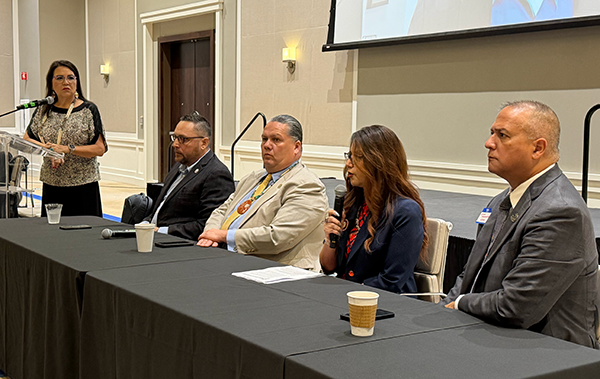
Tribal leaders and national Native organizations gathered Wednesday at the United Indian Nations of Oklahoma (UINO) March Quarterly Meeting at River Spirit Casino Resort for a roundtable discussion on the growing threat posed by unregulated prediction market wagering and its potential impact on tribal sovereignty and the lawful gaming industry.
The discussion, led by the Indian Gaming Association, focused on the expansion of so-called prediction markets that tribal leaders say are operating outside established gaming regulations under federal commodities law. Participants raised concerns about the role of the Commodity Futures Trading Commission (CFTC) in allowing platforms to offer contracts tied to sports and other real-world events.
Tribal leaders argued these contracts function as gambling but bypass the regulatory systems that govern both tribal and state gaming operations.
Roundtable participants included Christie Modlin, secretary of the Indian Gaming Association; Jason Giles, executive director of the Indian Gaming Association; Jacob Keys, chairman of the Iowa Tribe of Oklahoma; Larry Wright Jr., executive director of the National Congress of American Indians; and Jamie Hummingbird, representing the National Tribal Gaming Regulators and Commissioners.
IGA leadership briefed tribal leaders on the rapidly evolving national response to prediction market platforms and the growing coalition of tribal governments, states and gaming organizations working to address the issue.
“Tribal governments have built one of the most successful and responsibly regulated gaming industries in the world,” said Jason Giles, Executive Director of the Indian Gaming Association. “Prediction markets attempting to offer sports event contracts outside the established gaming regulatory framework threaten tribal sovereignty, consumer protections, and the economic foundation that supports tribal governments. Indian Country is working together with our partners across the gaming industry and with members of Congress to ensure these activities cannot bypass the law.”
Participants also discussed recent developments in Congress aimed at limiting prediction market wagering.
On March 4, U.S. Rep. Gabe Vasquez introduced an amendment during the House Agriculture Committee’s markup of the Farm, Food, and National Security Act of 2026. The amendment would reaffirm that federally regulated derivative exchanges cannot offer event contracts tied to sporting events or casino-style gambling.
The amendment has drawn support from tribal gaming organizations nationwide. Last week, the Indian Gaming Association, the California Nations Indian Gaming Association and the Washington Indian Gaming Association issued a joint statement backing the proposal, arguing that federal commodities law should not be used as a “backdoor” to authorize unlicensed sports betting nationwide.
Additional bipartisan legislation introduced by U.S. Reps. Blake Moore and Salud Carbajal would further strengthen federal oversight by directing the CFTC to prohibit event contracts tied to sports, elections, terrorism and other activities where the contracts effectively function as gambling rather than legitimate financial instruments.
“Tribal leaders across the country are speaking with one voice on this issue,” said Christie Modlin, Secretary of the Indian Gaming Association. “Prediction markets represent a clear attempt to sidestep the laws that govern gaming in the United States. Tribal governments have spent decades building strong regulatory systems that protect consumers and support tribal communities. We will continue working with Congress, states, and our industry partners to ensure those protections are not undermined.”
IGA leaders emphasized that tribal governments are working with national Native organizations, regional tribal gaming associations, the American Gaming Association and state leaders to build a coordinated national response.
According to industry leaders, the legal and regulated gaming industry supports hundreds of billions of dollars in economic activity nationwide, including more than $44 billion in tribal gaming revenue that funds tribal governments and essential services across Indian Country.
Tribal leaders warned that allowing unregulated prediction markets to expand nationwide could undermine existing regulatory systems and threaten a critical economic foundation for tribal communities.
The issue is expected to receive further attention at the upcoming Indian Gaming Tradeshow & Convention, scheduled for March 31 through April 3 in San Diego, where tribal leaders, regulators, policymakers and industry experts will gather to address emerging challenges facing tribal gaming.
The roundtable at the UINO quarterly meeting highlighted growing unity among tribal governments, national organizations and gaming industry partners as they work to defend tribal sovereignty and ensure all forms of wagering operate within established regulatory frameworks.