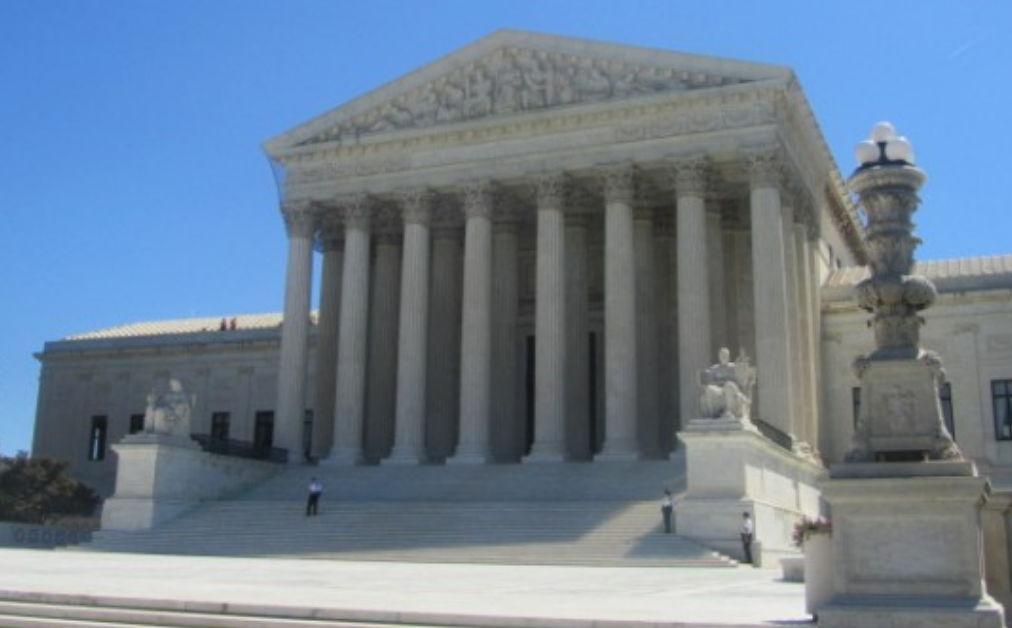
The United States Supreme Court declined today to hear a case seeking to shut part of a 645-mile oil pipeline in the Great Lakes.
In 2019, the state of Michigan, with support from various tribes, filed suit against Canadian energy company Enbridge to close an aging portion of Line 5, a 70-year-old pipeline that runs through the Straits of Mackinac, an area sacred to the Anishinaabe people. Advocates say an oil spill would be catastrophic, devastating Tribal lifeways and contaminating drinking water for more than 40 million people.
The energy company attempted to move the case to federal court, arguing that it implicates U.S. and Canadian trade; however, the company missed a filing deadline.
“Enbridge waited too long to remove this case to federal court,” Justice Sonia Sotomayor wrote for the unanimous ruling in a 14-page opinion .
The decision maintains a lower-court ruling that allows the lawsuit to proceed in state court.
“Today’s decision honors the truth that the Straits of Mackinac are not a bargaining chip and reaffirms what Tribal Nations have always known – we have the right and the responsibility to protect the Great Lakes,” Bay Mills Indian Community President Whitney Gravelle said in a statement. “The Supreme Court saw through Enbridge’s delay tactics and upheld the rule of law. This is a victory for our waters, our treaty rights, and the next seven generations who depend on the Great Lakes for life itself.”
In 2020, a judge issued a restraining order shutting the pipeline down, but it was allowed to continue operating after Enbridge met safety standards.
A year later, the company again tried to move the case to federal court, pointing to cross-border energy transportation. In 2024, the 6th U.S. Circuit Court of Appeals ruled that the company missed a 30-day deadline to change jurisdictions, sending the case back to state court.
The Great Lakes hold one-fifth of the world’s fresh water and are home to more than 4,000 species of wildlife, plants, and fish. Line 5 transports 23 million gallons of crude oil each day through Wisconsin and Michigan. It runs through several tribal nations, including the Bad River Band of Lake Superior Chippewa in Wisconsin and treaty-protected areas for the Bay Mills Indian Community in Michigan.
In 2010, a rupture of Enbridge’s Line 6B spilled 840,000 gallons of crude oil into the Kalamazoo River, resulting in more than a billion dollars in cleanup costs.