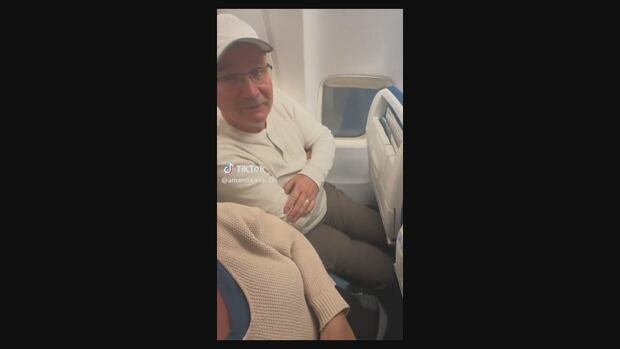
A viral video showing an Alberta family’s tight squeeze on a recent WestJet flight is prompting conversations about passenger legroom on Canadian airlines and whether the federal government needs to get involved.
On Dec. 26, 2025, Amanda Schmidt, her mother and father, Manfred Schmidt, were flying on WestJet from Edmonton to Toronto, en route to the Dominican Republic.
The family bought ultra-basic economy seats, which were non-reclining, and found their seating circumstances quite cramped.
A video posted to TikTok by Amanda shows her father, Manfred, who is 6’3″ tall and approximately 220 pounds, appearing uncomfortable in his seat.
“I could not get into the seat. I mean, I tried to get my knees in front of me … I’m a little bit taller than normal, maybe, but not a lot,” Manfred said.

“It was going to be like a four-hour flight. I was concerned about, OK, well, what are we gonna do? I mean, you can’t recline, you can’t move. You’re jammed in there like a sardine.”
Manfred said flight attendants later allowed him to sit in a seat with more legroom, but Amanda wants to see some accountability from the airline.
“It’s inhumane basically to make people travel like this and then also that it is a health and safety concern,” she said.
“When you buy a seat for a human, you should be able to expect it to fit a human safely.”

WestJet responds
WestJet declined an interview request, but in an email to CBC News said that the airplane in the video is “one of our newly reconfigured aircraft.”
The airline said it is trying to make air travel available to more Canadians by trying new products, such as aircraft that accommodate an extra row by changing seat pitch, which is the distance between the back of a seat to the back of the seat in front of it, thereby reducing legroom for passengers.
Some rows on certain WestJet aircraft have a 28-inch pitch (about 71 centimetres).
Later, on social media, the airline posted on X that it understands “that the reconfigured seating isn’t ideal for everyone” and said that it’s listening closely to feedback.
In December, the company paused a plan to install non-reclining seats on more planes after receiving negative feedback.
Pilots’ union reacts
The union representing WestJet pilots remains unhappy with the changes already made by the airline.
In a statement to CBC News, Captain Jacob Astin, chair of the WestJet Master Executive Council, which represents all WestJet Pilots, affirmed the pilots’ commitment to the highest safety standards.
“While the 28-inch seat pitch reconfiguration of many seats on 22 of our nearly 200-plane fleet is Transport Canada-approved, pilots recognize it reduces the superior safety margins of previous layouts due to cramping — legality ensures compliance, but not always optimal outcomes,” Astin said in the statement.
“The most successful airlines worldwide know that providing guests a safe and comfortable flying experience is a winning strategy; WestJet pilots believe this reconfiguration erodes the guest experience and devalues our brand.”
No regulations for legroom: aviation expert
According to John Gradek, an aviation expert at McGill University, a 30-inch pitch (about 76 centimetres) is typical in the Canadian airline industry.
While airplanes with reduced legroom are common in Europe, it is less common in Canada.
On top of that, Gradek said there are no federal rules around it.

“How WestJet decides to put the space between the seats, there is no oversight, there is no governance, there is no regulation associated with the amount of space that customers are entitled to,” he said.
The federal government should intervene, according to Gradek.
“When does the government step in to say enough is enough, that there is a certain set of customer service expectations that ought to be part of an airline ticket?” he said.
Manfred Schmidt, the passenger featured in the viral TikTok video, agreed that there should be a standard when it comes to legroom on a plane.
“I think the aviation authority should have some play in, kind of, standardizing the minimum requirements that our demographic and our culture requires,” he said.
“I don’t think there really should be seats where you cannot move in.“
CBC News reached out to Transport Canada asking if the department is considering whether legroom should be a passenger right. The department did not respond by deadline.