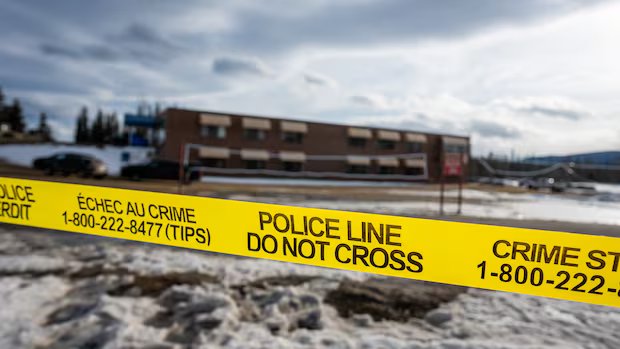
Three days after one of the deadliest mass shootings in Canada’s history, it’s still unclear how the shooter, who had a history of mental illness, got hold of the guns recovered at the two crime scenes.
Tragedy struck the quiet community of Tumbler Ridge, B.C., on Tuesday when 18-year-old Jesse Van Rootselaar shot her mother and half-brother at home before killing six others at the town’s high school — most of them children — and leaving two critically injured. She then killed herself, say police.
On Friday, police released more information about the number and type of guns involved, saying they are now investigating the use of four firearms — two retrieved from the school and two from the home.
But they said they still don’t know where the primary gun used in the school came from.
RCMP Deputy Commissioner Dwayne McDonald said the attacker used an unregistered shotgun to kill her mother and brother at their home. That shotgun has never been seized by police, he said.
Van Rootselaar then used different firearms at the school, he said.
McDonald said that firearm is “believed to be the one that caused the most significant damage” at the school and had never been seized by the RCMP.
“We’re trying to determine how our suspect got that firearm,” he said.
Police initially described one of the guns found at the school as a modified handgun. However, on Friday, they said it was a modified rifle, and its origin is unknown.
The information police have released about the guns raises questions about Canada’s gun laws given the shooter’s history.
Earlier this week, McDonald said over the years police made multiple visits to Van Rootselaar’s home on mental health concerns, including an instance when she was apprehended under the Mental Health Act and taken to hospital for assessment.

As the RCMP releases the identities of the eight victims killed in the Tumbler Ridge, B.C., mass shooting, many questions remain surrounding the tragedy. RCMP Deputy Commissioner Dwayne McDonald joins Power & Politics for an update on the ongoing investigation.
He also told reporters police had seized firearms from the home under the Criminal Code “a couple of years ago” but the lawful owner successfully petitioned for them to be returned.
In an interview with CBC’s Power & Politics on Thursday, McDonald said he couldn’t share more details about why the guns were returned, to whom and where, because the case is sealed due to a minor being involved at the time.
“In review of all previous incidents with respect to this individual and their family, police followed proper protocol and the law with respect to any firearms that may or may not come into our possession,” he told host David Cochrane.
“There are certain types of firearms, unrestricted, that do not have to be registered. So we’re trying to determine and trace the origin of all firearms,” he said.
On Friday, he said the shooter’s mother, Jennifer Strang, who was found dead at the family home, held a valid possession and acquisition licence (PAL). However, there were no firearms registered to that licence.
Police had previously said the shooter’s firearm licence had expired in 2024 and that no guns were registered under Van Rootselaar’s name.
Rod Giltaca, executive director of the Canadian Coalition for Firearm Rights, said there needs to be “accountability” as to how the guns were returned.
“I’d like to know what went into the decision,” he told CBC’s The National.
“What was the due diligence that the RCMP was involved in — and others from psychologists or whoever. I’d like to know what those steps that were taken were before those firearms were returned to a clearly inappropriate environment.”
How Canada’s ‘red flag’ laws work
Under Canada’s “red flag” laws, anyone can apply for an emergency prohibition order if they have concerns about someone who owns a firearm. If a judge agrees the individual poses a safety risk to themselves or others, they can order the person’s firearms, firearm licence and any other weapons be removed for up to 30 days.
A hearing is needed if a longer prohibition period — up to five years — is requested.
According to Public Safety Canada, once an order expires or a judge is convinced to cancel it, the owner gets their firearms, weapons and other items back as soon as possible.
There’s also something in Canadian law called an emergency limitations on access order. This court order can be made if there is a risk that someone who is not allowed to have firearms or other weapons due to a court order could gain access to another person’s firearms, according to Public Safety.
For example, a court could require a person that lives with someone subject to an emergency prohibition order to store their firearms at a licensed friend’s home instead of their own, according to the federal department.
While the RCMP has suggested mental health played a role in why firearms were seized, it is still unclear what type of order was used in the case and if conditions were issued when they were returned.
Asked if he’s comfortable with Canada’s “red flag” laws as written, McDonald said mental health and firearms are always going to worry law enforcement.
“It’s something that we, not just in the RCMP, but all police forces have to manage and something that we are incredibly mindful of,” he said.
A photo Strang posted in August of several long guns in a cabinet with the caption, “Think it’s time to take them out for some target practice,” has been shared widely on social media.
Speaking Thursday, McDonald said he’s aware of social media posts, but cannot confirm yet if the crime scene guns and the guns in the family house are connected.
“I’m not saying that we don’t know, but there are still a couple of avenues of investigation that we’re pursuing,” he said.
Make and model unknown
Police have still not released the makes and models.
Questions about which firearms were used in Tumbler Ridge come as the federal government is in the middle of rolling out a delayed, politically unpopular and logistically challenging national gun buyback program.
Following the 2020 mass shooting in Nova Scotia, when a gunman killed 22 people, Ottawa moved to ban some 2,500 makes and models of what the federal government calls “assault-style” firearms.
The government, both under former prime minister Justin Trudeau and now Prime Minister Mark Carney, have argued the outlawed firearms are designed for warfare — not hunters and sport shooters — and promised to compensate owners.
The policy has seen a spike in backlash from the Opposition Conservatives and firearms-rights groups who argue the government is targeting law-abiding gun owners and not criminals, who they argue are unlikely to participate in the program.

Hundreds of people gathered in Tumbler Ridge, B.C., on Wednesday to attend a candlelight vigil in memory of the victims of the mass shooting that occurred the day before, including six children. (CORRECTION: Feb. 13, 2026 | Emmett Jacobs is described in this video as Jesse Van Rootselaar’s stepbrother. In fact, Emmett’s father has since confirmed he was Van Rootselaar’s half-brother.)
After multiple delays, the federal government launched the consumer buyback in January giving owners until March 31 to declare their firearms before collection begins.
Owners who don’t submit their declaration by the deadline won’t be compensated.
The amnesty period for possessing banned guns will end on Oct. 30. Anyone in possession after that “will be breaking the law and could face criminal prosecution.”
But with Alberta and Saskatchewan setting up legislative roadblocks and few police forces signing on, collection could prove to be difficult. The government has suggested it will rely on the RCMP and mobile collection units.
Ottawa has budgeted about $250 million to pay for an estimated 136,000 outlawed firearms from individual Canadians.
But the minister’s own commitment to the program has been questioned.
In September, Public Safety Minister Gary Anandasangaree found himself in hot water after he suggested in an audio recording that an acquaintance shouldn’t worry about being arrested for refusing to turn in a banned firearm because municipal police have few resources to devote to such matters.
The minister was also recorded saying the buyback was in part being done because the issue is important to Quebec voters.
In a statement at the time, Anandasangaree said his comments were “misguided.”